
Cockroaches
Cockroach eggs and cockroach droppings: how to recognize them and what they mean
- The eggs come in a brown case 5 to 8 mm long called an ootheca. The German cockroach carries it attached to its body; the American cockroach glues it in corners.
- German cockroach droppings look like ground pepper or coffee grounds. American cockroach droppings are ridged cylinders about 2 mm long that get mistaken for mouse droppings.
- Finding egg cases or fresh droppings means there is an active nest less than two meters away, not a cockroach passing through.
- No spray kills the eggs. That is why gel is applied over 2 to 3 visits. House up to 100 m²: ₡39,900 including VAT.
The short answer
That hard brown case, shaped like a flattened bean or a tiny coin purse, is an ootheca: the case in which the cockroach lays its eggs. It measures between 5 and 8 millimeters. And those little black specks that look like ground pepper in the corner of the drawer, or coffee grounds behind the microwave, are cockroach droppings. Neither one shows up on its own: both mean there is an active nest nearby, almost always less than two meters from where you found them.
They are also the two most useful signs for knowing which species you have, where it is and how big the problem is. This guide explains how to read them, what to do with what you found and why spray won't solve an infestation when eggs are involved.
What the egg case (ootheca) looks like
In Costa Rica there are two cockroaches that matter inside the house, and their egg cases behave differently:
- German cockroach (the small one, 1 to 1.5 cm, honey colored with two dark stripes on its back). Its ootheca is light brown, elongated, 6 to 8 mm, with a seam line along the edge. It holds 30 to 40 eggs. The female carries it attached to her abdomen until one or two days before it hatches, so seeing a female with the case sticking out is a sign that up to 40 nymphs will come out within hours. You almost never find full, loose German cockroach egg cases; empty ones, yes, in the same hiding places where they leave droppings.
- American cockroach (the big one, 3 to 4 cm, reddish brown, the one that comes in through the drain). Its ootheca is dark brown, almost black, about 8 mm, and plumper. It holds about 15 eggs. The female glues it with saliva in a sheltered corner: behind a baseboard, inside a cardboard box, in the slot of a hinge, under the bathroom sink. That is why it is common to find them stuck in place, sometimes several together.
If you want to confirm which species yours is, the guide to the German cockroach has comparison photos.
Where egg cases show up
Cockroaches glue or drop their egg cases where it is warm, dark and undisturbed:
- Hinges and rails of cupboard doors and drawers. Check the hinge gap with a flashlight.
- Behind and under the refrigerator, in the motor grille: warm all year and nobody cleans it. The same goes for the motor of the microwave and the coffee maker.
- Cardboard boxes in the storage room or under the kitchen sink. Corrugated cardboard is the favorite place to lay eggs and the most common way cockroaches get brought home from the supermarket.
- The cabinet under the bathroom sink, where the pipe goes through the wood.
What cockroach droppings look like
It depends on the size of the insect, which is why droppings help identify the species:
- German cockroach and nymphs: black or dark brown specks, less than a millimeter, like ground pepper or coffee grounds. On vertical surfaces they also leave smeared stains, like ink splatters, because their excrement is more liquid. They pile up in the corners of drawers, where the baseboard meets the wall and around hinges.
- American cockroach: cylinders about 2 mm long, dark brown or black, with ridges running lengthwise and blunt (cut-off) ends, not pointed. They show up on the bathroom floor, behind the toilet, in the storage room and near drains.
How to tell them from mouse droppings. It is the most frequent mix-up and it changes the treatment. Mouse droppings measure 3 to 6 mm (two or three times longer), have pointed ends, are smooth with no ridges, and appear in a line along the wall where the mouse runs. American cockroach droppings are shorter, with ridges you can see by zooming in with your phone camera, have cut-off ends, and are found where it is damp and dark.
If you are still not sure, the guide to diagnosing a cockroach infestation goes over the other signs: smell, shed skins and where they come out at night.
What finding them means
A single American cockroach in the bathroom may be a visitor from the drain. But an egg case or a buildup of droppings is no longer a visit: it is a population that eats, defecates and breeds in your home.
- Fine droppings piled up in a drawer or corner: less than two meters away is the main German cockroach harborage, the species that grows fastest (a female produces 4 to 8 egg cases in her lifetime, and nymphs start breeding at two months).
- Glued egg cases and ridged cylinders: American cockroaches settled indoors, almost always in a bathroom, laundry room or damp storage room.
- Fresh droppings (black, shiny, smear when touched) mean activity this week; old ones are dull and dusty.
- Droppings of different sizes in the same place: there are adults and nymphs, so they are breeding right there.
The real risk: allergens and asthma
A cockroach doesn't make you sick because you saw it. The problem is the buildup: German cockroach droppings, saliva and shed skins dry out, turn to dust and stay in the air. Those particles are recognized allergens, linked to asthma attacks and rhinitis, especially in children who live in infested homes. And the cockroach that walks from the drain to the countertop carries bacteria such as salmonella onto food. That is why cleaning up the residue is part of the treatment.
What to do with what you found
- Don't crush the egg case on the surface. The case is hard, it withstands the blow, and all you accomplish is scattering viable eggs into the surrounding cracks.
- Vacuum or pick up with paper the egg cases, droppings and shed skins, and throw everything out in a sealed bag outside the house. If you used a vacuum, empty the canister right away.
- Clean with degreaser or hot soapy water. Droppings carry pheromones that attract more cockroaches to the same corner; if the trail stays, they come back to the same spot.
- Throw out the cardboard boxes in that area and move what you kept in them to plastic containers with lids.
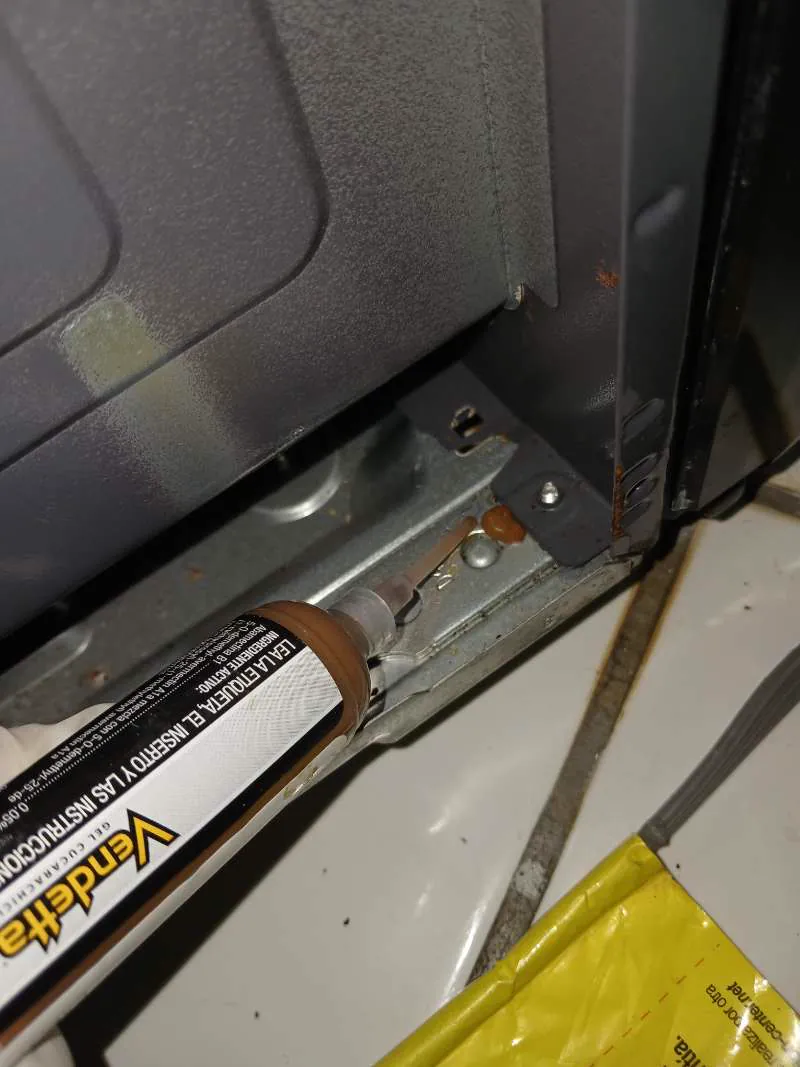
- Don't spray where the gel is going to go: it repels and scatters the colony to other rooms, and it contaminates the bait.
Why spray doesn't kill eggs and gel does solve the problem
"I fumigated and three weeks later they were back" has a simple biological reason: no contact insecticide gets through the ootheca. Spray kills the adults and nymphs it touches that day, but the egg cases stuck in the hinges and the ones carried by hidden females keep developing. In 3 to 4 weeks they hatch and you see small cockroaches again.
That is why German cockroach treatment is done with bait gel in small spots inside the hiding places and in 2 to 3 applications spaced weeks apart. The first eliminates the population already walking around. The following ones wait for the nymphs to come out of the remaining egg cases; when they eat the gel, they die before they can breed. Gel doesn't repel: they eat it, carry it to the nest, and a nymph that eats droppings from a poisoned cockroach also dies. That chain effect is what a spray can't do. The full procedure is on the cockroach control page.
How much it costs
House or apartment up to 100 m²: ₡39,900 with VAT included, with no travel fee in the GAM. Up to 200 m² ₡49,900 and over 200 m² ₡59,900. It covers gel at the spots where the eggs and droppings are and an inspection of the source. If you have not fumigated in the last 6 months, it takes two applications and the second one is charged; the 30-day check only applies once the plan is complete. Date confirmed by WhatsApp in less than an hour, and you can go back into the house one hour after the treatment.
Frequently asked questions
How long does it take for a cockroach egg case to hatch?
The German cockroach ootheca hatches in about 3 to 4 weeks, and the female carries it for almost all of that time. The American cockroach's takes longer, between 1 and 2 months depending on the temperature. A case you find stuck somewhere may be empty (they already hatched) or full.
Are cockroach droppings dangerous?
Yes, in an infested home: German cockroach droppings, saliva and shed skins are recognized allergens that worsen asthma, especially in children. They also carry bacteria from drains and trash to food. It is not a medical emergency, but it is a reason not to let it grow.
Can I kill cockroach eggs with spray or bleach?
No. The case protects the eggs from insecticide and bleach. What works is removing the ootheca (vacuum it or pick it up with paper) and throwing it out in a sealed bag. Whatever stays hidden is eliminated by the gel when the nymphs come out to feed.
How much does cockroach treatment cost in Costa Rica?
House or apartment up to 100 m²: ₡39,900 including VAT, up to 200 m² ₡49,900 and over 200 m² ₡59,900, with no travel fee in the GAM. If you have not fumigated in the last 6 months, it takes two applications and the second one is charged; the 30-day check only applies once the plan is complete.