
Wasps and Bees at Home: How to Tell Them Apart, What to Do With the Nest, and Who to Call
✓ Pest control company licensed by the Ministry of Health · ✓ Open 24 hours, every day · ✓ Prices published on our website
Wasp nest: quoted on WhatsApp based on the nestPest control company licensed by the Ministry of Health · Available 24/7
- Send us a photo of the nest taken from a distance: we will tell you whether they are bees or wasps and what needs to be done.
- Wasps: nest removal with protective gear. Bees: coordination with a beekeeper or the Fire Department.
- 30-day check once the plan is complete, with conditions
- Open 24 hours, every day
If a nest has shown up under the eaves, in the meter box or inside a wall, the first step is not buying a spray can but figuring out what it is, because bees and wasps are handled in opposite ways. A bee looks fuzzy and round, flies heavily, and its nest is a wax honeycomb with hexagonal cells, almost always inside a cavity. A wasp looks smooth, shiny and narrow-waisted, flies fast and jittery, and its nest is made of gray paper and hangs out in the open. A photo taken from a distance is enough to tell them apart without getting close.
The difference matters because bees are relocated, not sprayed: in Costa Rica most wild colonies are Africanized, very defensive, and removing them is a job for a beekeeper or the Fire Department, not a spray can. An active wasp nest attached to the house, on the other hand, does get removed, with the right gear and at the right time.
- Bee: fuzzy, round, stings once. Wasp: smooth, narrow-waisted, stings several times.
- Wax honeycomb inside a cavity: bees. Gray paper nest in the open: wasps. Mud nest: mud dauber, harmless.
- Africanized bees: do not remove them yourself. They are relocated by a beekeeper or the Fire Department; they are not sprayed.
- Active wasp nest attached to the house or with allergic people around: removed with proper gear. Quoted on WhatsApp based on the nest.
- Never gasoline, fire or hitting the nest. Allergy or many stings: emergency, 9-1-1.
Contents
- Bee, wasp or hornet: how to tell which one it is
- The nests: wax, paper or mud
- Africanized bees in Costa Rica: why you don’t remove them yourself or smoke them out
- Wasps: when to remove the nest and when to leave it
- What to do if you get stung
- Allergy and emergencies: when to call 9-1-1
- What never to do
- How EcoPlagas handles it
- Prevention: eaves, sweets and the March check
- How we treat it (real photos)
- Frequently asked questions
Bee, wasp or hornet: how to tell which one it is
- Honeybee. 1 to 1.5 cm long, with a fuzzy, stocky body, dull brown with dark bands, and a heavy, direct flight. It stings only once: the stinger stays in the skin and the bee dies. Away from the hive it almost never attacks.
- Wasp. Smooth, shiny body with a pinched waist, yellow and black or reddish brown depending on the species, with a fast, jittery flight. It stings several times, defends a wide perimeter and responds as a group to vibration. The most common ones around homes are paper wasps (Polistes) and closed-nest wasps (Polybia and relatives), which are very defensive.
- Hornet. Here people call any large wasp a hornet, but true hornets (Vespa) do not live in the Americas, and the Asian hornet (Vespa velutina) has not been reported in Costa Rica. The large dark insect people see is usually a large paper wasp, a tarantula hawk (solitary and not very aggressive) or a large beetle.
- Stingless bees (mariolas, jicotes). Small and dark, they nest in wall cavities with a trumpet-shaped wax entrance. They do not sting. They are native and valuable: they are relocated, never killed.
The nests: wax, paper or mud
Often you can’t get a good look at the insect but you can see the nest, and the nest tells you almost everything.
- Wax honeycomb, with hexagonal cells, yellow to dark brown, almost always inside a cavity: a hollow concrete block wall, a ceiling, a meter box, a tree trunk, an empty tank, with steady bee traffic through a hole. These are honeybees, which in Costa Rica are almost always Africanized.
- Gray paper nest, made of chewed wood fiber, hanging in the open under eaves, a beam, a light fixture or a branch: either like an open umbrella with the cells visible (Polistes) or like a closed ball with a single entrance (Polybia, the most aggressive). These are wasps.
- Mud nest, small mud tubes stuck to the wall, under the eaves or in a high corner of the house. This is the mud dauber (Sceliphron): solitary, black with yellow legs, it hunts spiders for its larvae. It does not defend the nest and almost never stings. Scrape it off with a putty knife when the wasp is away, or leave it: it keeps spiders in check.
Africanized bees in Costa Rica: why you don’t remove them yourself or smoke them out
Since the 1980s, most wild honeybee colonies in Costa Rica have been Africanized: the same insect, the same honey, but far more defensive. A European colony sends out a few guards; an Africanized one can respond with hundreds of bees to a vibration, an engine or a person several meters away, and it chases over long distances. That is the difference between a few stings and an emergency.
That is why no one should try to remove a beehive on their own, with or without a spray can. And it is not sprayed either: the bee is a pollinator under pressure, and killing a colony inside a wall leaves kilos of honey and brood rotting there, which attracts cockroaches, ants and other bees. The right approach is relocation: a beekeeper with proper equipment removes the colony and takes it away. In emergencies with swarms on public roads, at schools or with people being stung, the Fire Department responds at 9-1-1. SENASA, which regulates beekeeping, and many municipalities ask that colonies be relocated rather than destroyed: it is the right thing to do and in most cases it is required.
While you wait for the right people to arrive: keep children and pets away, don’t walk under the nest, keep machinery away, close the windows on that side of the house, and don’t block the entrance of a hive inside a wall: if you cut off their exit to the yard, they come out into the house.
Wasps: when to remove the nest and when to leave it
Wasps are useful too: they hunt caterpillars, flies and spiders. A paper nest in a tree at the back of the lot, away from where people walk, can be left alone; at the end of the season the colony dies off. Mud daubers and solitary hunting wasps are never removed.
A nest does need to be removed when:
- It is active and attached to the house: eaves above the door, a window frame, the meter box, a porch light, inside the ceiling or a wall.
- It is where people walk: the entrance, the carport, a play area, the pool.
- Someone in the house is allergic, or there are babies or older adults who cannot get away quickly.
- It is a closed Polybia-type nest, which attacks as a group with little provocation, with people nearby.
An over-the-counter spray aimed from below only reaches the surface, kills the wasps on the outside and leaves the queen and brood inside: what you end up with is an agitated colony at face height. The right way to remove a nest is described below.
What to do if you get stung
- Get away immediately, walking fast and protecting your face; wasps and Africanized bees give chase and sting as a group. Don’t jump into water: they will be waiting for you when you come up.
- If it was a bee, remove the stinger by scraping it out with the edge of a card or a fingernail, not with tweezers, which squeeze out more venom.
- Wash with soap and water and apply cold for 10 minutes, several times.
- An oral antihistamine and a common pain reliever ease the itching and pain.
- Local pain and swelling last one or two days. If the area later becomes hot, very red and has pus, see a doctor.
Allergy and emergencies: when to call 9-1-1
It is an emergency if any of these signs appear in the minutes after a sting: difficulty breathing or wheezing, swelling of the lips, tongue, face or throat, hives all over the body away from the sting, dizziness, fainting, vomiting or a racing pulse. This is a severe allergic reaction (anaphylaxis). Call 9-1-1, and if the person has an epinephrine auto-injector, use it without waiting.
You should also go to a medical center when there are many stings (several dozen in an adult or more than ten in a child), when the sting was in the mouth or throat, or for babies and older adults with any general symptom. Anyone who has already had an allergic reaction should treat any nest near the house as urgent.
What never to do
- Gasoline, diesel or kerosene on the nest: burns, eave fires, and the agitated colony attacks anyway.
- Fire or a torch. Wooden eaves, a ceiling, wiring and an angry swarm coming out of the flames.
- Hitting the nest, throwing rocks at it or spraying it with a hose. Vibration is the signal to attack.
- Climbing a ladder to spray it. Most serious injuries are not from the stings but from falling when you react.
- Blocking the entrance of a nest inside a wall or ceiling: they come out on the inside, into the rooms.
- Spraying at night with a flashlight: the light draws the ones that fly out straight toward whoever is holding it.
How EcoPlagas handles it
The first thing we will ask for is a photo of the nest taken from a distance, zoomed in, on WhatsApp. With that we identify whether they are bees, wasps or a mud dauber, and we tell you what needs to be done without anyone putting themselves at risk or spending money on a spray that will make things worse.
If they are wasps and the nest needs to be removed, a technician in a suit and face shield applies an approved product directly to the nest at dawn or dusk, when they are all inside, removes the entire nest so no brood is left, treats the attachment point so they don’t rebuild, and tells you what to seal. If it is inside a wall or ceiling, the entrance and the cavity are treated and we assess whether it needs to be opened. The price is quoted on WhatsApp based on the nest: size, height, whether it is in the open or inside a structure, and access.
If they are bees, we don’t spray them. We help you coordinate with a beekeeper to relocate the colony, and if it is an emergency (a swarm on a public road, people being stung, a school or health center) we tell you to call the Fire Department at 9-1-1. After the relocation, if there is a cavity left with wax and honey residue, we do treat and seal it so other bees, cockroaches or ants don’t move in.
Prevention: eaves, sweets and the March check
- Seal eaves and gaps in concrete blocks. Unplastered blocks, vent holes without screens, broken meter boxes and gaps in the ceiling are the favorite cavities of bees and closed-nest wasps. The guide to sealing your home covers each spot one by one; the same work keeps out the spiders that mud daubers come to hunt.
- Check in March and April. At the end of the dry season, wasp queens start new nests and bee swarms look for a cavity before the rains. A paper wasp nest in April has one queen and six cells and takes a minute to remove; by August it has two hundred wasps. Walk around once a week checking eaves, light fixtures, meter boxes and empty tanks during those two months.
- Don’t leave sweet food outside. Juice, fallen fruit, uncovered trash and the pet’s bowl draw wasps to the porch, especially at the end of the rainy season.
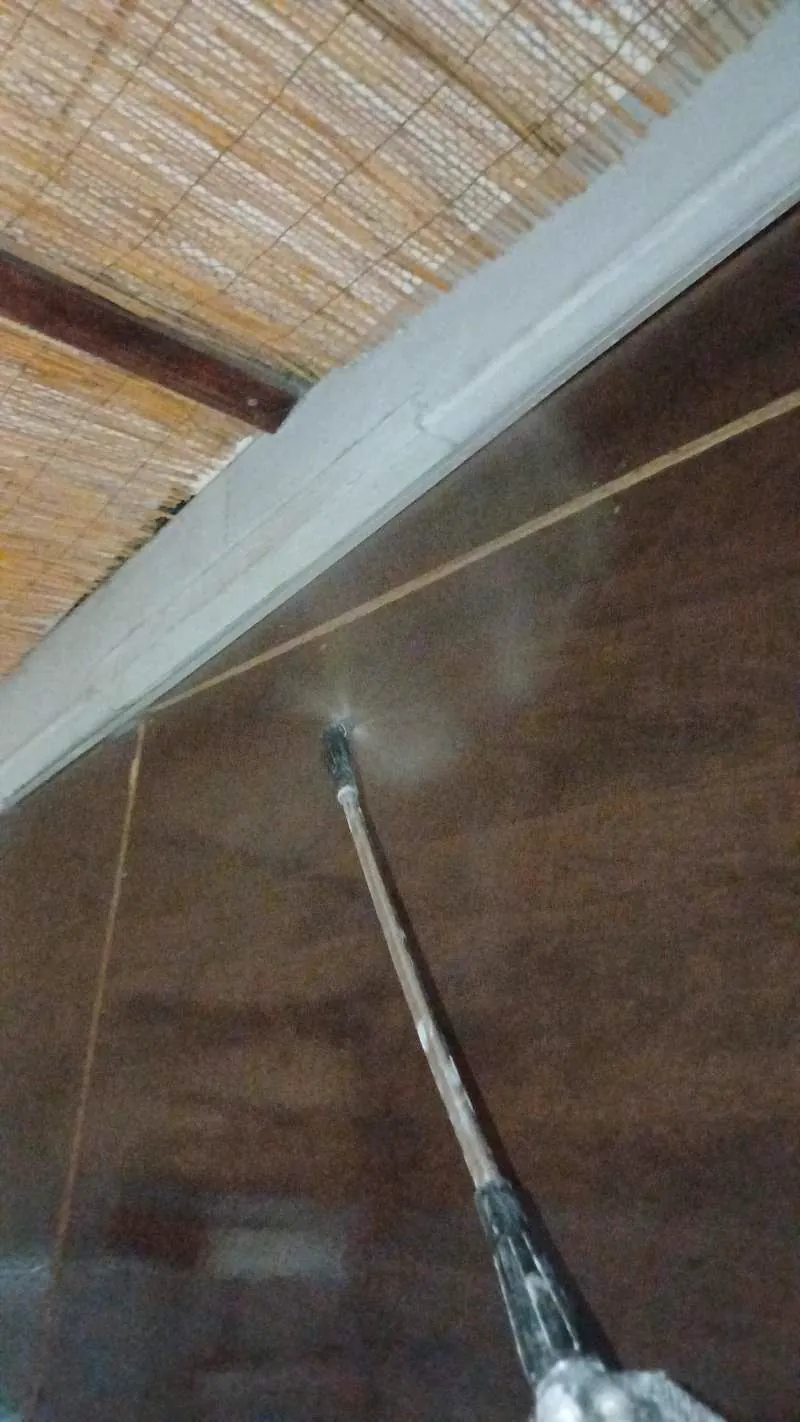
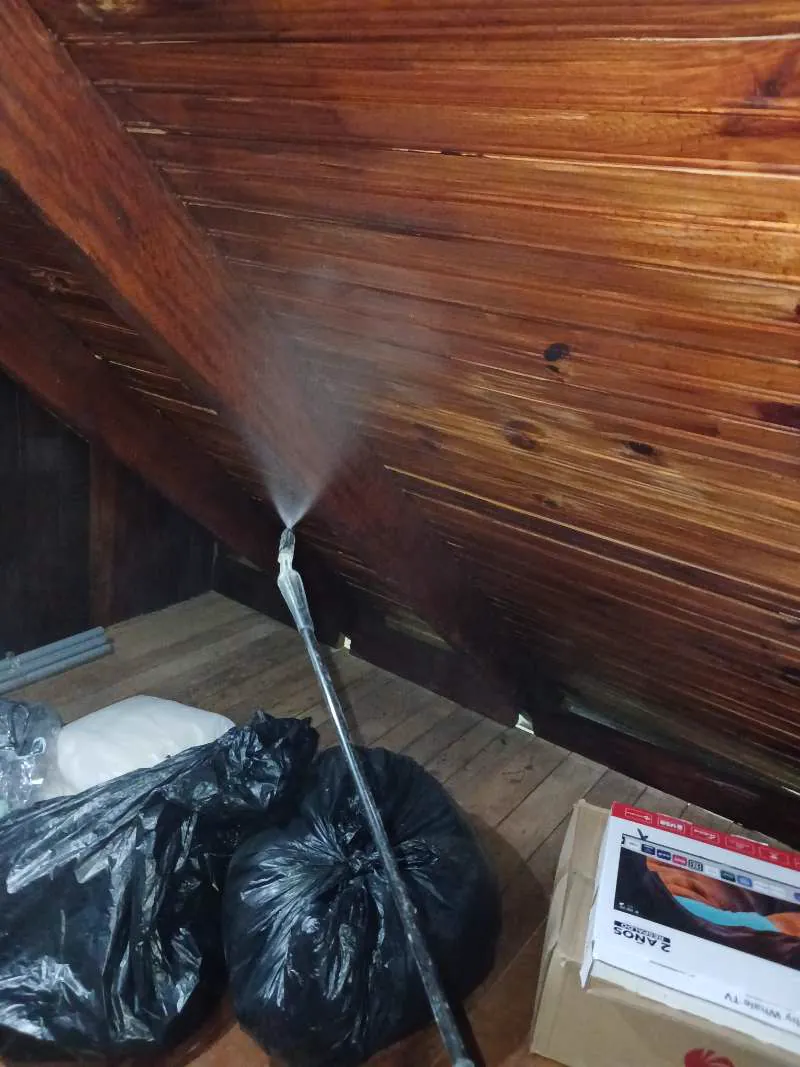
How EcoPlagas handles eaves and ceilings
Photos from real jobs, taken from our technicians’ recent reports.
Frequently asked questions
- How can I tell a bee from a wasp without getting close?
- By the body and the nest. A bee is fuzzy and round, flies heavily, and builds a wax honeycomb inside a cavity. A wasp is smooth, shiny and narrow-waisted, flies fast, and builds a gray paper nest that hangs out in the open. A zoomed-in photo taken from a distance is enough to decide.
- Do you spray bees?
- No. Bees are relocated by a beekeeper, who removes the colony and takes it away. In emergencies with swarms on public roads or people being stung, the Fire Department responds at 9-1-1. After the relocation, we do treat and seal the cavity so it does not get occupied again.
- Is the Asian hornet in Costa Rica?
- It has not been reported. Hornets of the genus Vespa do not live in the Americas. What people here call a hornet is usually a large paper wasp, a tarantula hawk (solitary and not very aggressive) or a large beetle.
- What should I do if a wasp or bee stings me?
- Get away quickly while protecting your face. If it was a bee, scrape the stinger out with a card. Wash, apply cold and take an antihistamine. Call 9-1-1 if there is difficulty breathing, swelling of the face or throat, hives all over the body, or dizziness.
- Is the mud nest on my wall dangerous?
- No. It belongs to the mud dauber, a solitary wasp that hunts spiders and almost never stings. You can scrape it off with a putty knife when the wasp is away, or leave it; it does not form a colony or defend the nest.
- How much does it cost to remove a wasp nest?
- We quote on WhatsApp based on the nest: size, height, whether it is out in the open or inside a wall or ceiling, and access. Send us a photo taken from a distance and we will reply with a price and a date.