
Rodents
How to Get Rid of Mice Without Poison: Traps, Sealing and What Actually Works
- Skipping loose poison is the right call if you have children, pets or chickens, or you don't want a dead animal inside the wall.
- First find out whether it's a house mouse or a roof rat: it changes where the traps go.
- Snap traps baited with peanut butter, flush against the wall, checked every day. We don't recommend glue traps.
- What keeps them from coming back is sealing entry points and removing food.
- The professional option without loose poison: locked bait stations, 4 for ₡48,900.
When it makes sense to avoid poison
There are four cases where hardware-store poison is a bad idea even though it works. With small children in the house, because the pellets look like cereal. With dogs and cats, which eat the bait or eat the poisoned mouse. With chickens or birds in the yard. And when you don't want to risk the smell of a dead rat inside the wall: a poisoned rodent goes off to die where nobody can reach it, and the smell lasts two or three weeks.
The good news is that for house mice, poison was never what works best. Traps and sealing are. And for roof rats, when bait is needed, there's a way to use it without leaving it loose, which we cover at the end.
House mouse or roof rat: it changes everything
The house mouse is 6 to 9 cm long without the tail, leaves droppings like grains of rice, lives in the kitchen and the pantry, and moves along the wall a few centimeters above the floor. It rarely makes noise in the ceiling.
The roof rat is three times bigger, leaves droppings 1 to 2 cm long with pointed ends, and runs at night through the ceiling and along cables. It comes in from the roof, not from the ground. If what you hear is scurrying overhead at midnight, you have rats, and the traps need to go up there. If what you see are little black pellets behind the stove, it's mice, and you work down low. What to do the first night is in mice in the house: what to do.
Snap traps and live traps: how to use them right
Snap trap (the classic spring trap). It's the most effective and the cheapest. Bait: a pea-sized dab of peanut butter stuck to the trigger. The cartoon cheese dries out and falls off. Set it flush against the wall with the trigger facing the wall, along the animal's route: behind the fridge, under the sink, in the pantry, next to the gas tank. For house mice, 4 to 6 traps; for rats, 6 to 10, and up on the beams. Mouse traps are small and won't kill a rat: buy rat-size traps if it's a rat.
Live trap (the cage or the tube with a door). Useful if you don't want to kill the animal. Same bait, same spot. The problem is what to do afterward: if you release it less than a kilometer away, it comes back. Release it far away, in a vacant lot or green area, and don't leave it in the cage more than a day.
Rules for both: wear gloves to set and to dispose (human scent scares them off and droppings carry disease), check them every day, leave the traps baited but unset for two nights so they get used to them, and set them all on the same night. Dispose of the animal in a double bag.
Glue traps: why we don't recommend them
Glue boards are sold everywhere and catch small mice. We don't recommend them for three reasons. The animal stays alive, suffers for hours and squeals; many people don't know what to do with it. They almost never catch roof rats, which are the ones making the noise: a rat is heavy enough to pull free or rip the board loose. And they stick to things they shouldn't: the cat's tail, a child's foot, a lizard. If you already have one, use it only inside a cardboard box with a hole, never left open on the floor.
Sealing: the part that keeps them from coming back
A mouse fits through a 6 mm hole, the width of a pencil. A rat, through 2 cm. Walk around the house with a flashlight and look for: where the pipes for the laundry sink and the bathroom sink pass through, the gap under the kitchen door, the hole for the air conditioner cable, the eaves and the roof ridge, the drain grate in the yard.
Pack the gaps tightly with steel wool (the kind for scrubbing pots works) and cover it with polyurethane foam, putty or cement. Without the steel wool, they chew through foam alone. On doors, a brush door sweep. On the roof, mesh over open eaves and branches cut back 1.5 meters. Seal after trapping, not before, or you lock the animal inside.
Cleaning and cats: what helps and what doesn't
Cleaning does help, a lot: pet food in a container with a lid and put away at night, no crumbs behind the stove, trash cans with lids, fruit in the fridge, the sink dry before bed. A mouse needs very little, but if the house gives it nothing, traps baited with peanut butter become the most attractive thing around.
A cat helps with house mice moving across the floor, especially an outdoor cat. With roof rats it helps little: a cat doesn't climb into the ceiling, an adult rat weighs nearly as much as a cat is willing to take on, and many house cats just watch it go by. Don't adopt a cat to solve a rat problem. And if you already have a cat, that's one more reason not to use loose poison.
The professional option without loose poison
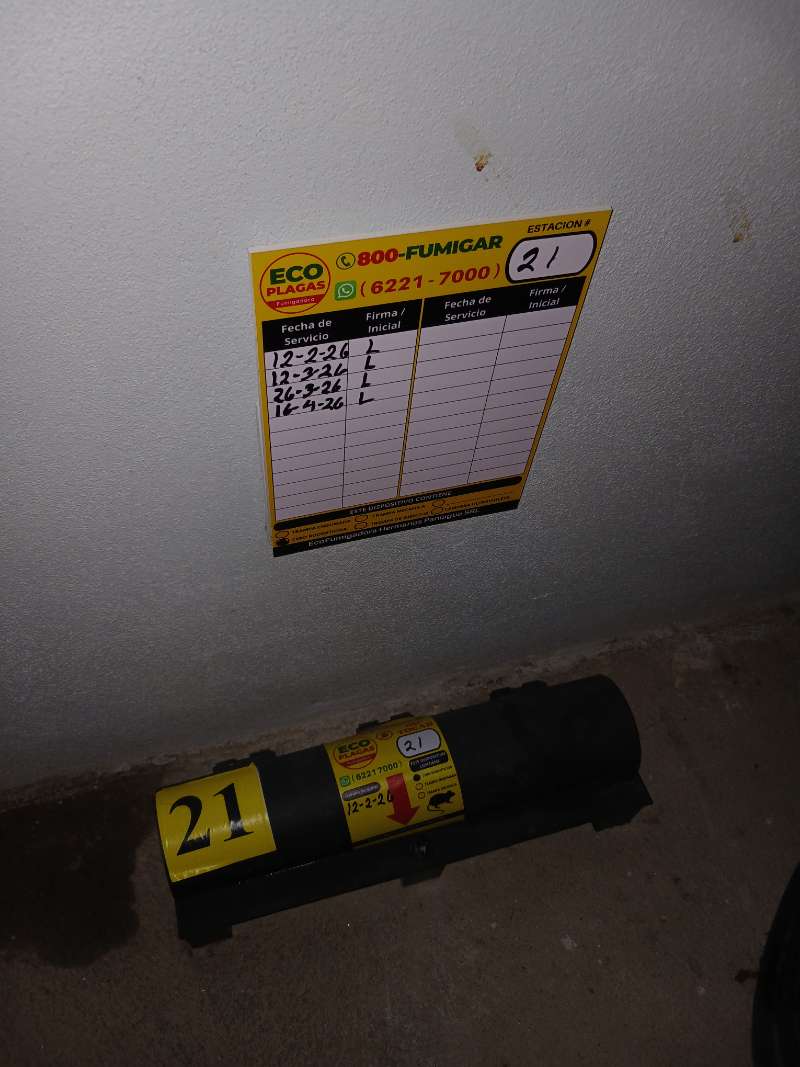
When traps aren't enough, the problem is roof rats, or it's been going on for months, what EcoPlagas does is install locked bait stations: hard plastic boxes with a lock, anchored in place, with the bait inside a compartment that only a rodent can reach through a tunnel. A child can't open one, a dog can't move it, a cat can't reach the bait. They're numbered and dated, placed around the outside perimeter and along the roofline. The technician shows you where they're getting in. At 15 days we check which stations had bait eaten, which tells us where they move and when it's over. If you'd rather not have any bait inside the house, the stations can go on the outside perimeter only. Service details are in rodent control, and about the products, in rat poison.
If you have pets at home, also read is fumigation safe for pets. Installation in 24 to 72 hours, date confirmed in under an hour on WhatsApp, service 24 hours a day, every day, nationwide. Re-entry one hour later. Licensed by the Ministry of Health.
How much it costs
4 stations installed: ₡48,900 (CRC). 8 stations, for a large house or a lot with a fruit tree: ₡79,900. Includes the 15-day inspection. Prices on the prices page. Phone 6073-1000, WhatsApp 6030-0045.
Frequently asked questions
Can you get rid of mice without any poison?
Yes. For house mice, snap traps baited with peanut butter, set flush against the wall and in good numbers, plus sealing and cleaning. Roof rats usually need bait, but inside locked bait stations.
What bait works best in a trap?
Peanut butter, a pea-sized dab stuck to the trigger. Sausage or ripe fruit tied on with thread also works. Use little bait so the trap fires.
Are locked bait stations safe around children and dogs?
Yes. The bait sits in a locked inner compartment, anchored in place, that only a rodent can reach through a tunnel. No poison is left loose.
Will a cat solve the problem?
It helps with house mice on the floor. With roof rats, hardly at all, because a cat does not climb into the ceiling and avoids adult rats.