
Rat poison: which one works, which one doesn't, and how to use it without putting anyone at risk
✓ Pest control company authorized by the Ministry of Health · ✓ Licensed chemical oversight
4 stations installed from ₡48,900Pest control company authorized by the Ministry of Health · Available 24/7
- Bait inside a locked station: safe around children and pets.
- 30-day check once the plan is complete, with conditions
- Back inside one hour later
- Date confirmed in less than an hour
If you landed here looking for rat poison, chances are you have already heard something in the ceiling, found droppings behind the fridge or seen a chewed cable. This page is not a service brochure: it is what we would explain to a neighbor who asks us what to buy and how to use it. In many cases you can solve it yourself, and we will tell you when.
- Loose poison kills the rat where you can't reach it and stays within reach of children and pets.
- The professional alternative: bait inside locked stations, numbered and dated.
- 4 stations installed for ₡48,900.
Contents
- What types of rat poison are there
- Why loose poison is the worst way to use it
- The poison "that dries them out and leaves no odor": what's true
- Do it yourself or call a professional?
- How to place the stations: where, and how often to check them
- The six mistakes that make baiting fail
- Traps or poison: when to use each
- Rodent bait stations ready to place
- Frequently asked questions
What types of rat poison are there
Almost everything sold in Costa Rica as rat poison falls into three families. It is worth knowing which one you are buying, because they differ in the risk to your animals and in how long it takes to see results.
1. First-generation anticoagulants
Warfarin, chlorophacinone and diphacinone. The rodent has to eat for several days in a row to build up a lethal dose. That sounds like a drawback, but it has a real advantage: if your dog steals a bite, the risk is much lower than with second-generation products, and they have a known antidote, vitamin K1 given by a veterinarian.
2. Second-generation anticoagulants
Brodifacoum, bromadiolone, difethialone and difenacoum. A single feeding is usually enough. They are the most used in professional control because they work fast, but they persist longer in the body and they are the ones that cause secondary poisoning: the cat, the dog or the owl that eats the poisoned rat also gets the dose. That is why in professional control they are used inside a locked station, with records and carcass removal.
3. Non-anticoagulants
Bromethalin (a neurotoxin), cholecalciferol (vitamin D3 in a massive dose) and zinc phosphide. They act faster and are useful when resistance to anticoagulants is suspected. The downside is serious: they have no practical antidote. If there are pets in the house, these are not the first ones we would recommend.
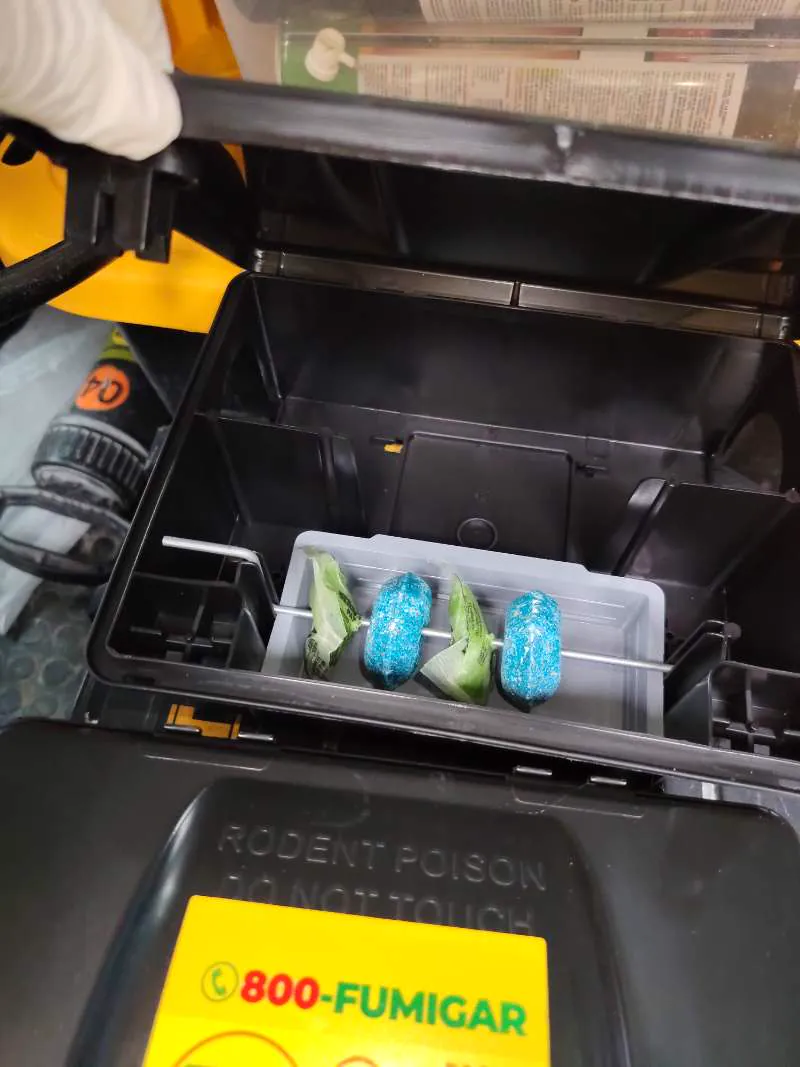
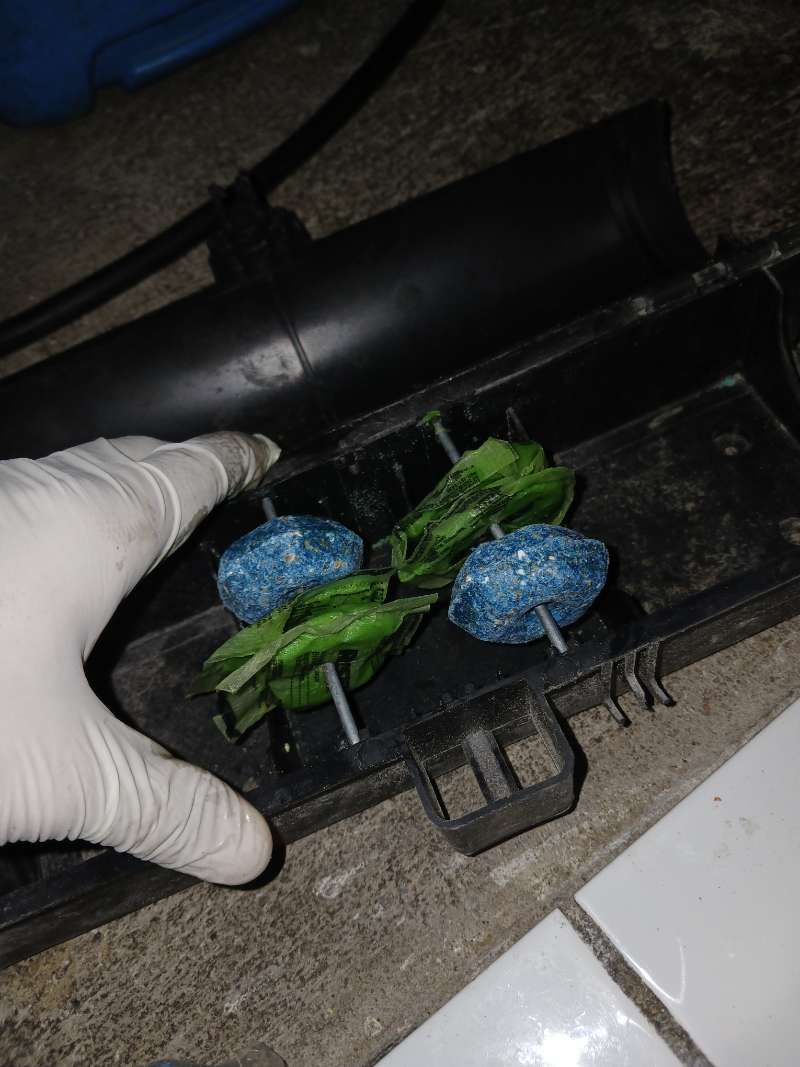
What almost nobody tells you: the format matters as much as the molecule. The paraffin block stands up to humidity and heat, attaches to the rod inside the box and can't be carried off. Loose pellets and grain get wet, go moldy and get dragged out of the station. In the Costa Rican climate, go with blocks.
Why loose poison is the worst way to use it
The typical scene: someone buys a packet of blue grains and scatters it on a plate behind the refrigerator or in the corner of the patio. That fails for four reasons at once.
- It is within reach of the wrong ones. A crawling toddler, a curious dog, a hen. The blue grain is exactly the size and color that attracts a child's hand.
- It breaks down. With rain or humidity the bait goes moldy within days and the rodent stops eating it. You think the rats are gone, when what really happened is that the bait spoiled.
- It gets carried off. Rats haul food to their nest. Loose bait ends up in places you didn't choose, including your neighbor's garage.
- It can't be measured. Without a station there is no way to know how much they ate or where, which is the only information that tells you where the problem is.
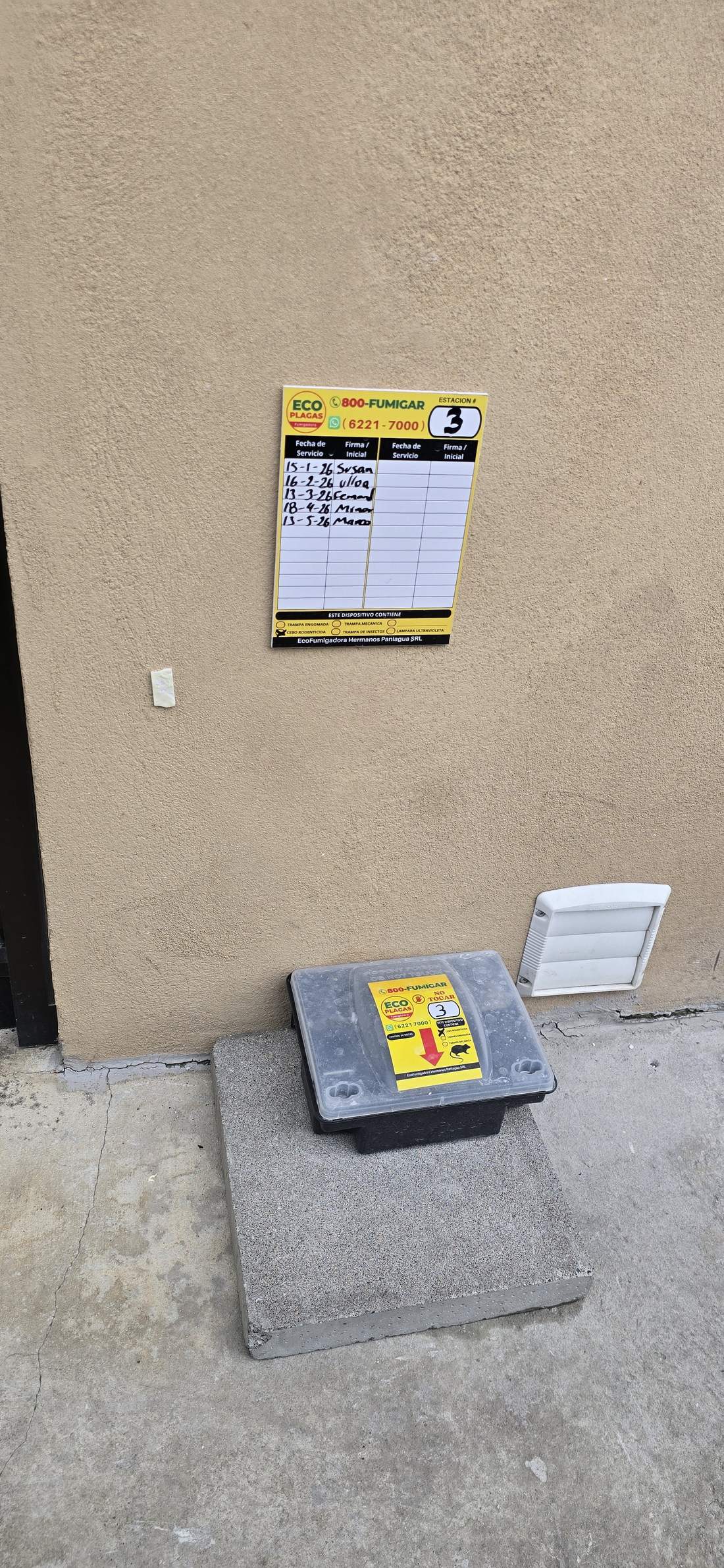
The right way is the bait box, or bait station: a locked plastic box with an entrance of about five centimeters that a rodent can pass through but a child's hand or a dog's snout cannot, with the block secured to an internal rod and the box anchored to the floor or the wall.
The poison "that dries them out and leaves no odor": what's true
It is the most repeated search and it deserves a straight answer: that product does not exist. No rodenticide dehydrates, mummifies or evaporates the animal. It is chemically impossible at the doses a bait contains.
Where the myth comes from: anticoagulants cause slow internal bleeding, and some of the affected rodents go out looking for water and open air. Many die outside, so in many homes the odor really never appears and people conclude the poison "dried them out". But it is not a sure thing, it is a probability. When the animal dies inside a wall, a ceiling or a piece of furniture, there is odor, and it lasts one to three weeks depending on the size of the animal, the heat and how well the space is ventilated.
How it is really handled:
- Bait the outside perimeter, not inside the house. If the bait is outside, the rodent eats outside and is far more likely to die outside.
- Inside the house, use traps. A trap kills on the spot and leaves the body in plain sight so you can remove it. It is the only way to have zero odor indoors.
- If the odor has already appeared, find the spot where it is strongest, ventilate and, if it is accessible, remove the body with gloves and a double bag. Deodorizers and ozone help you get through it, but as long as the body is there the odor comes back.
Do it yourself or call a professional?
Here is the part that doesn't help us commercially, but it is the truth.
Do it yourself, you don't need to hire anyone
- You saw a single rat in the yard, on the patio or near the compost.
- There is a mouse in the kitchen and the droppings are concentrated in a single cabinet.
- The activity started after construction or a trench in the neighborhood and is dying down on its own.
- You have a small storage room or a garage where you only want to keep preventive pressure.
This is when a professional makes sense
- You hear running in the ceiling every night: that is an established colony, not a single animal.
- There are droppings in several rooms or on different floors of the house.
- Chewed cables have appeared, which is also a fire hazard, or a chewed water pipe.
- It is a food business, a soda, a restaurant or a warehouse inspected by the Ministry of Health, where you will be asked for a logbook and a station map.
- You have been baiting for more than two or three weeks and feeding is not going down: either there are more animals than you think, or the population is being replenished from a source you haven't found.
- You suspect a nest inside the structure, between floors or inside a double wall.
If your case is on the second list, check out the rodent control service, which includes an inspection, a station map and a logbook. If it is on the first, keep reading and buy the boxes: it will cost you less and it will work.
How to place the stations: where, and how often to check them
Rats and mice travel hugging the walls, with their whiskers brushing the surface. They almost never cross an open space if they can avoid it. All the placement logic comes from that.
Where each box goes
- Against the wall, with the box entrance parallel to the wall, never in the middle of the patio.
- On the outside perimeter of the house or business: perimeter walls, the shared wall, the edge of the garage, near the meter, next to the laundry area.
- At resource points: near the trash cans, the bag of animal feed, the compost, the chicken coop, the grain storage.
- Near drains and inspection boxes, which is where the brown rat gets in.
- In warehouses, along the inside baseboard, in the corners and behind the stacks.
How many, and how far apart
- Rats: one station every 8 to 15 meters. They move 30 to 50 meters around the nest.
- Mice: one station every 3 to 5 meters. They move very little, 3 to 10 meters, which is why more points are needed.
- A house on a standard lot is handled with 2 to 4 boxes on the perimeter. A large lot, a commercial space or a warehouse needs 6 to 12.
How often to check
- Day 3: first check. If they ate nothing, don't switch products yet: the brown rat is neophobic and can take three to seven days to accept a new object.
- Weekly for the first two to three weeks, replacing the block in the boxes where there was feeding.
- Every 15 to 30 days in the maintenance phase, once there is no more feeding. The block gets replaced anyway even if it is intact, because it goes rancid.
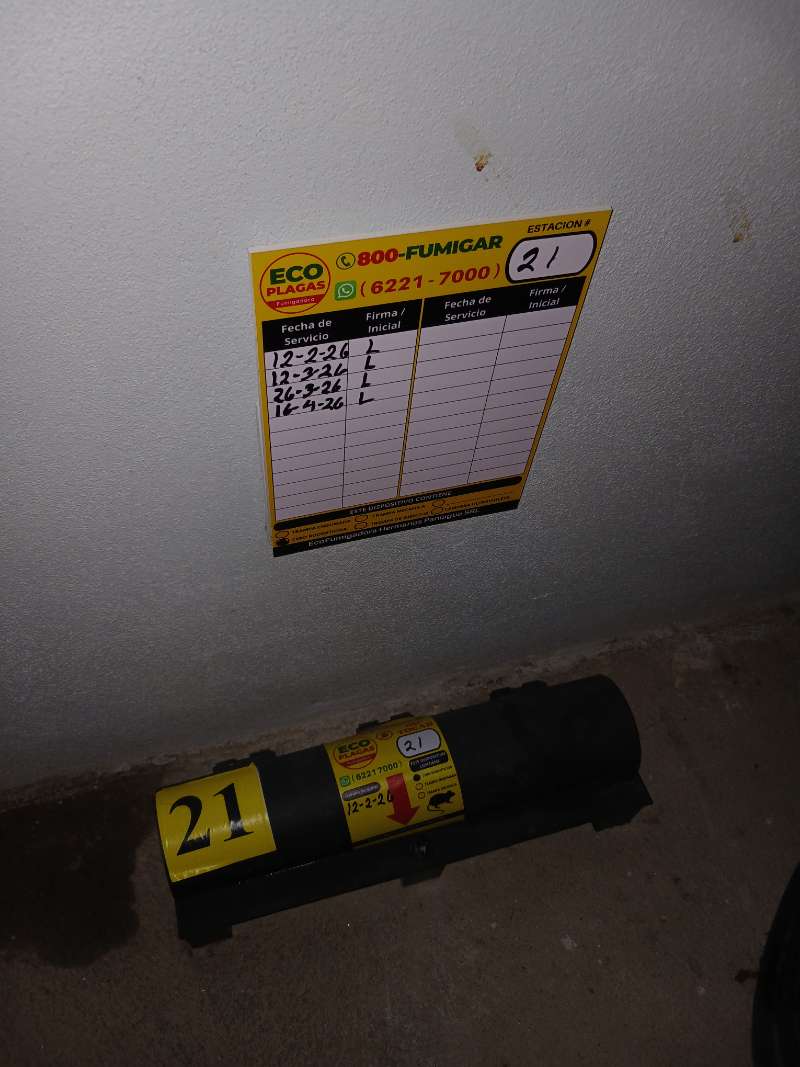
- Write down feeding per box. A simple piece of paper taped on with the date and how much was missing. The box that gets eaten the most is telling you where the nest is.
This is what a properly set-up station looks like. Photos from real jobs by our technicians.
The six mistakes that make baiting fail
- Moving the box every two days. This is mistake number one. A rat needs days to work the object into its routine. If you move it, you reset the clock every time.
- Handling the bait without gloves. Human scent on the block is enough for them to reject it. Always wear gloves, also for your own safety.
- Leaving competing food. If there is an open bag of animal feed, uncovered trash or fallen fruit next to the box, the bait loses. Close up the pantry first, then bait.
- Using too little bait. Half a block isn't enough for a population. If a box is completely eaten, put in more, not less.
- Removing everything at the first result. Feeding drops, the noise stops, the boxes come out. Six weeks later it all comes back. The perimeter stays in place permanently.
- Baiting without sealing the entry points. As long as there is a gap under the door, a broken grate or an unsealed pipe opening, new ones get in. Bait lowers the population, exclusion keeps it from rebuilding. Both, not one.
Traps or poison: when to use each
It's not a war, they are different tools.
- Snap trap, the classic spring trap: the best option inside the house. It kills quickly, leaves the body in plain sight and has zero risk of odor in the walls. It needs to be checked and reset.
- Bait in a station: the best option outdoors, in the garage and in the storage room. It works at night without supervision and covers more ground. It doesn't control where the animal dies.
- Glue trap: we advise against it. The animal stays alive, sometimes for hours, and it is a needlessly cruel death. It also catches lizards and small birds.
- Ultrasonic repellers: they don't work over time. Rodents get used to the sound within days. Don't spend money on them.
The setup we use on a real job, and that you can replicate: bait stations along the entire outside perimeter, traps indoors, and sealing the entry points we find. If you want to learn to read the problem before buying, the blog has a guide on the signs that you have rats or mice at home.
Rodent bait stations ready to place
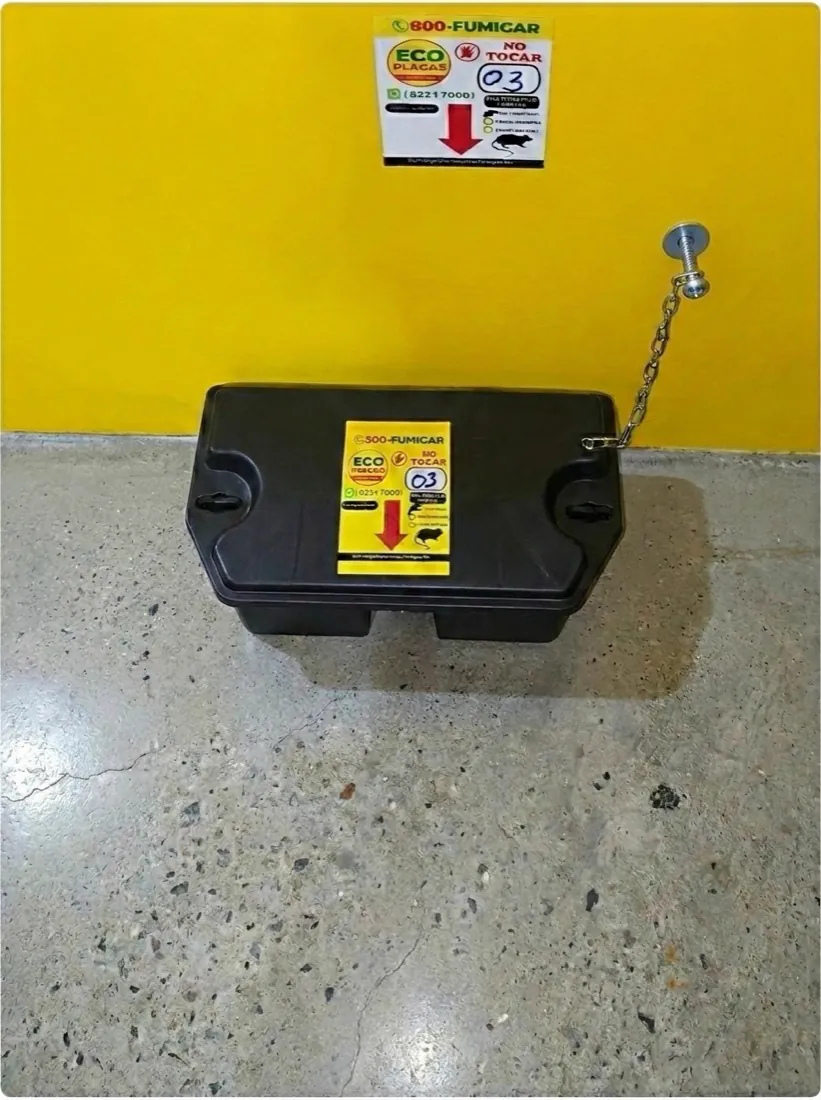
We sell the complete station online, with the bait inside and ready to place. It is exactly the same equipment our technicians use on service calls, not a retail version. You can pay by card or SINPE Móvil, and shipping is free nationwide through Correos de Costa Rica: the product ships to any province, although fumigation service with a technician is limited to the Greater Metropolitan Area.
The smallest pack is 4 boxes for ₡39,000 (₡9,750 each) and the price per box drops sharply with volume: the 24-pack works out to ₡5,792 each. For a house, the 4-pack is usually enough. For a business or a warehouse, the 8-pack and up.
After you pay, we arrange shipping over WhatsApp. If you would rather have a technician do the inspection and place the stations, that is the rodent control service.
Frequently asked questions
What is the best rat poison?
There isn't one that is best for every case. Second-generation anticoagulants work with a single feeding, but they carry the highest secondary risk for cats, dogs and birds of prey. First-generation ones are slower and safer around pets. What really decides the result is not the molecule: it is the format, a paraffin block, and the placement, on the route the rodent already uses.
Is there a rat poison that dries them out and leaves no odor?
No. No rodenticide dehydrates or mummifies the animal. What happens is that many affected rodents go out looking for water and die outside, so the odor never reaches the house. If they die inside a wall, there is odor, for one to three weeks. Bait outside and use traps inside: that does control the odor.
What poison works on large rats?
The brown rat, or sewer rat, is the large one and the most wary. What works for it is a paraffin block in a locked station, anchored against the wall and left in place. The problem is almost never the product, it is moving the box or removing it too soon.
Is rat poison safe if there are children or pets?
Only inside a locked, anchored station with the block secured. There are two risks: that the dog or the child eats the bait, and that the cat eats the poisoned rat. Anticoagulants have a veterinary antidote, vitamin K1, but it requires prompt care. Bromethalin and cholecalciferol have no practical antidote. With young children at home, bait only the outside perimeter.
How long does it take to work?
With anticoagulants, three to seven days from when they start eating, and that delay is on purpose: if death were immediate, the rest of the colony would associate the bait with danger and stop eating it. Add three to seven more days of initial wariness before they try the new box. In total, one to two weeks to see a real drop in activity.
Do mouse traps work better than poison?
Indoors, yes, because you can remove the body. Outdoors, bait covers more ground and works on its own. The right approach is to combine the two.
What if the rat becomes resistant?
Resistance to first-generation anticoagulants has been documented in some populations. The warning sign is sustained feeding for weeks without activity going down. The way out is to rotate to an active ingredient from another family, not to increase the dose of the same one.