
Termites
How to Get Rid of Termites in Wood: Step by Step and What Not to Do
- Sand-like pellets under the furniture: drywood termites. Mud tubes coming up from the floor: subterranean termites.
- Spray and kerosene kill what they touch; the colony is inside and the product doesn't penetrate.
- With a small piece of furniture you can act yourself: isolate it, sun, inject wood treatment into the holes, seal.
- Door frames, ceilings and beams are not a DIY job.
- Free inspection with a motion detector; furniture from ₡59,900 (CRC); structures from ₡299,900 to ₡499,900 per 100 m².
First, identify it: drywood or subterranean
In Costa Rica there are two kinds of termites (locally called comején) that attack homes, and they're treated differently. Look at the damage before you buy anything.
Drywood termites. They live inside the furniture, frame or beam, with no contact with the ground. The sign is a small pile of pellets like fine sand, the same color as the wood, under or next to the piece: it's their droppings, pushed out through tiny holes 1 to 2 mm wide. If you sweep up the pile and another one appears within a week, the colony is active. They attack furniture, doors, frames, closets and wooden ceilings.
Subterranean termites. They live in the soil and climb up to the wood through mud tubes as thick as a pencil, stuck to the wall, the column or the baseboard. They need moisture and go back to the soil every day. They attack door frames, wood floors, structures in contact with the ground and any damp wood.
A third case that gets mistaken for termites is woodworm: round holes 1 to 3 mm wide with a coarser dust and no pellets. It has its own page: woodworm. To compare photos, see how to identify termites and how to tell if my house has termites.
Why spray and kerosene won't cure the furniture
The first thing almost everyone does is spray the furniture with a hardware store aerosol, or soak it in kerosene or diesel "the way grandpa did." It kills the termites on the surface and in the first few millimeters. The colony isn't there: it's in the internal galleries, sometimes 5 or 10 cm deep, with the queen and thousands of individuals. The liquid doesn't penetrate the sound wood around the galleries, and the termites seal the holes from the inside when they sense the smell. The result: two weeks without pellets, and then they come back.
Kerosene also leaves the furniture smelling for months, stains it, and is a fire hazard in a ceiling. And repellent spray can push the colony into another nearby piece of wood.
What you can do with a small piece of furniture
If the problem is a table, a chair, a picture frame, a box or a door you can take out, there's a reasonable do-it-yourself procedure.
- Isolate it. Take it out of the house, or at least move it away from other wooden furniture and from the ceiling. If it fits in a large plastic bag, even better.
- Direct sun for two or three days in a row, turning it over. Drywood termites die above 50 degrees (122 °F), and the inside of a piece of furniture in the midday sun gets close to that.
- Inject wood treatment into every hole. At the hardware store, ask for an insecticidal wood preservative (there are permethrin-based and borate-based ones) and a syringe or a fine-tip applicator. Inject until the hole overflows, one hole at a time. Where the wood sounds hollow, drill a 2 mm hole every 10 cm and inject there too.
- Seal the holes with wax or wood filler. That way, if new pellets show up in two or three weeks, you know the colony is still alive and where it's coming from.
- Check again after a month. If there are new pellets, the furniture needs professional treatment or, if it isn't worth it, you need to get rid of it before the termites move to another piece.
Wear gloves and a mask, and do it outdoors: these products are not meant to be applied in a closed kitchen.
When it's structural and no longer a DIY job
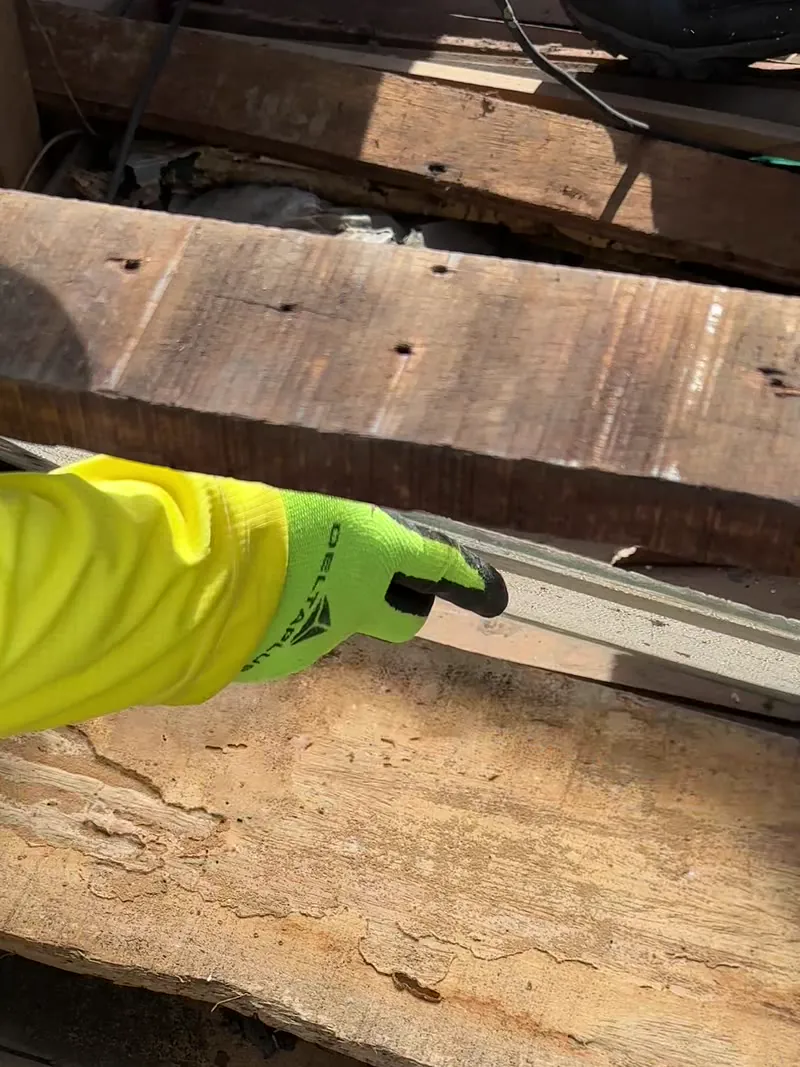
There's a clear line. If the termites are in door and window frames, ceilings, beams, wooden columns, floors, built-in closets or the roof structure, it's not a DIY job. Three reasons. You can't isolate a frame or put it in the sun. You don't know how far the colony reaches: the visible damage is the tip, and the galleries can run for meters behind the plaster. And if they're subterranean, the colony is in the soil under the house, and no matter how much you inject the beam, they'll climb back up.
Other signs that it's already structural: the wood sounds hollow when you tap it with a screwdriver handle, the paint bubbles or ripples with no visible moisture, a door sticks because the frame gave way, identical transparent wings show up on the floor or at the window after a rain (they're the reproductives that leave to start new colonies), or there are mud tubes on more than one wall.
How it's treated professionally
Treatment starts with a free inspection. The technician goes through the house frame by frame, taps the wood to find hollow spots, looks for sawdust or fine powder and goes up into the attic to check beams and boards: that way you know where the colony is alive and how far it reaches, not just where the damage shows. With that, you get a written quote during the same visit.
For drywood termites, the technician drills and injects product into the galleries under pressure, piece by piece, in all the wood with activity and in the sound wood around it, and treats the surface with a residual preservative. For subterranean termites, besides the wood there's a soil treatment: a termiticide barrier around the perimeter and at the points where they climb up, to cut the path between the colony and the house. After that there's a six-month follow-up with checkups to confirm there's no new activity, because termites can't be evaluated in a week.
Date confirmed in under an hour by WhatsApp, service 24 hours a day, every day, nationwide. You can go back into the house one hour later. Authorized by the Ministry of Health. The full service is on termite control.
Prevention: what keeps termites out
- Moisture. Fix leaks, broken gutters and seepage in bathrooms. Subterranean termites need moisture to climb up; damp wood is the first they attack.
- Wood in contact with the ground. Posts, baseboards and frames that touch the soil are a direct bridge. Raise the wood on a concrete or metal base.
- Firewood and boards against the wall. Store them away from the house and off the floor.
- Used furniture. Check under the legs and at the joints before bringing it into the house. Many drywood infestations arrive in a piece of furniture someone bought.
- Yearly check of frames, ceiling and storage room with a flashlight, tapping the wood.
How much it costs
The inspection is free. Furniture treatment, from ₡59,900. Structural treatment, from ₡299,900 to ₡499,900 per 100 m² depending on whether it's drywood or subterranean and on the extent; the exact price is put in writing at the inspection, before any work starts. Prices on the prices page. Phone 6073-1000, WhatsApp 6030-0045.
Frequently asked questions
How do I know if the termites are active?
Sweep up the pellets under the furniture or break off a piece of the mud tube. If there are new pellets within a week, or the tube has been repaired, the colony is alive.
Do spray or kerosene work on termites?
No. They kill what's on the surface, but the colony lives in internal galleries the liquid can't reach. The termites seal the holes and come back within weeks.
Can I treat a piece of furniture with termites myself?
If it's a small piece you can take out of the house, yes: isolate it, leave it in the sun for two or three days, inject wood preservative into every hole and seal. If the pellets come back within a month, it needs professional treatment.
How much does it cost to get rid of termites?
The inspection with a motion detector is free. Furniture from ₡59,900; structures from ₡299,900 to ₡499,900 per 100 m², in writing at the inspection.