
Mosquitoes
The dengue mosquito (Aedes aegypti): how to recognize it and get it out of your home
- Black with white stripes on its legs and a white lyre pattern on its thorax. It bites during the day, flies low and goes for the legs.
- It breeds in containers of clean water in and around the house: flowerpot saucers, vases, tires, clogged gutters, uncovered tanks.
- From egg to adult in 7 to 10 days. Eggs stuck to the container survive dry for months.
- What brings the population down most is checking breeding sites every week. Spraying helps during an outbreak or in a large yard: ₡39,900 up to 100 m².
The dengue mosquito, Aedes aegypti, is easy to recognize: it is black with white stripes on its legs and has a white lyre-shaped pattern on its thorax, just behind the head (two curved lines on the sides and two straight ones in the middle). It is small, smaller than the brown nighttime mosquito, it bites during the day, flies low and goes for ankles and calves. If you find it resting on the bathroom wall or under the bed in mid-afternoon, that's the one.
The other thing to know from the start: this mosquito lives in and around the house. It doesn't breed in the river, the creek or the big puddle in the street. It breeds in clean, still water inside small containers, a few meters from where you sleep. That's bad because it's close to you, and good because you can do much more than the Ministry of Health to get rid of it.
How to recognize it in 5 seconds
- Legs with white rings, clearly marked, like striped socks.
- White lyre on the thorax, visible if you look closely or in a phone photo.
- Size: 4 to 7 mm, more compact than the nighttime mosquito (Culex), which is plain brown and longer.
- Behavior: it bites during the day, barely buzzes and bites several times because it startles easily and comes back.
- Where it rests: indoors in dark, cool places: behind curtains, under the bed, inside the closet, in the bathroom. Outdoors, in dense vegetation and under eaves.
There is a cousin, Aedes albopictus, striped but with a single straight white line on the thorax instead of the lyre. It also transmits dengue; for what you're going to do at home, it makes no difference which one it is.
Where it lives and when it bites
The female lays her eggs on the inside wall of containers with water, just above the waterline, and spreads them across several containers to be safe. In her whole life (about 2 to 4 weeks) she doesn't travel more than 100 to 200 meters from where she was born. In practice, the mosquito biting you was born at your house or your neighbor's.
It bites mostly in the early morning and the last hour before dark, but inside a lit house it can bite at any time. In the rainy season, from May to November, breeding sites multiply and the population rises within two or three weeks (more in rainy season pests). But Aedes doesn't disappear in the dry season: it stays in tanks, laundry sinks and vases with water all year.
Typical breeding sites in a Costa Rican home
This is what we find again and again when we inspect yards in the Greater Metropolitan Area:
- Flowerpot saucers and vases with standing water, including water plants and the "aloe in water" in the kitchen.
- Tires in the yard, on the roof of the shed or used as planters. They are the perfect breeding site: dark, warm and always holding water.
- Gutters clogged with leaves, which hold water for a week after it rains.
- Tanks, drums and laundry sinks without a lid, or with a lid that doesn't close properly.
- Buckets, basins, bottles and bottle caps facing up. A soda cap with water breeds mosquitoes.
- Pet water bowls that are never washed, only refilled.
- Tarps, inflatable pools and toys in the yard.
- Inside the house: the drip tray under the refrigerator, the tank of an unused toilet, the drain of the laundry sink that isn't used and the vase on the table.
The cycle: 7 to 10 days and eggs that last for months
With Costa Rica's heat, it takes 7 to 10 days to go from egg to adult mosquito. That sets the rule: if you check and empty containers once a week, no larva gets to fly. If you do it every two weeks, they're already out.
The detail almost nobody knows: eggs stuck to the container wall survive dry for months. Emptying the flowerpot saucer isn't enough; you have to scrub it to remove the eggs. If you only empty it, they all hatch with the first rain.
Dengue symptoms and when to go to the EBAIS
Dengue starts 4 to 10 days after the bite with a sudden high fever, severe headache, pain behind the eyes, muscle and joint pain, sometimes a rash. It lasts a week. What you need to watch is the moment the fever drops, between day 3 and day 7: that's when the warning signs appear.
Go to the EBAIS (public health clinic) or the emergency room the same day if there is: strong, continuous abdominal pain, repeated vomiting, bleeding gums or nose, blood in vomit or stool, drowsiness or irritability, difficulty breathing, or cold hands and feet. In the meantime: fluids, rest and acetaminophen. No aspirin or ibuprofen, because they increase the risk of bleeding. If you have a fever in a neighborhood with cases, see a doctor: diagnosis is made with a blood test, and the EBAIS report triggers the Ministry's response in your area.
What the Ministry of Health does and what's up to you
When cases are reported, the Ministry of Health fogs the neighborhood with space spraying (the machine that puffs smoke from the street or house by house), carries out yard inspections and, in tanks that can't be emptied, applies larvicide. That kills the adults flying that day and interrupts transmission while people are sick.
What the Ministry can't do is check your flowerpot saucer every week. Fogging doesn't reach the larvae in the water, so if the breeding sites remain, there are new mosquitoes within a week. Spraying buys time; eliminating breeding sites breaks the cycle. Neither replaces the other.
What actually brings the population down
- A weekly check of the yard and the house, on the same day every week so you don't forget. Empty, scrub and turn over.
- Lids that close on tanks, drums and laundry sinks. If there is no lid, mosquito netting tied on with a rubber band.
- Larvicide in water you can't empty (storage tanks, fountains, laundry sinks in use): the Ministry provides it free at the EBAIS and it is safe for household water if the dose is followed.
- Screens on windows and a net over the crib, window mesh in good condition and doors that close.
- Repellent on people during biting hours. Which ones work and which don't, in mosquito repellent: which one really works.
- Talk to your neighbors. If the yard next door has five tires, the mosquitoes keep coming. In a condo, the breeding site is usually in common areas: gutters, planters, the pump room.
More detail and a printable checklist in dengue in Costa Rica 2026: the breeding sites nobody checks.
Residential spraying: when it makes sense and what it costs
Spraying by a private pest control company helps when there is an outbreak in the neighborhood and people at risk live in the house (babies, pregnant women, older adults or someone who has already had dengue); when the yard is large, with lots of vegetation, or borders a vacant lot, river or coffee field and the population doesn't drop even though your breeding sites are under control; or before an outdoor event.
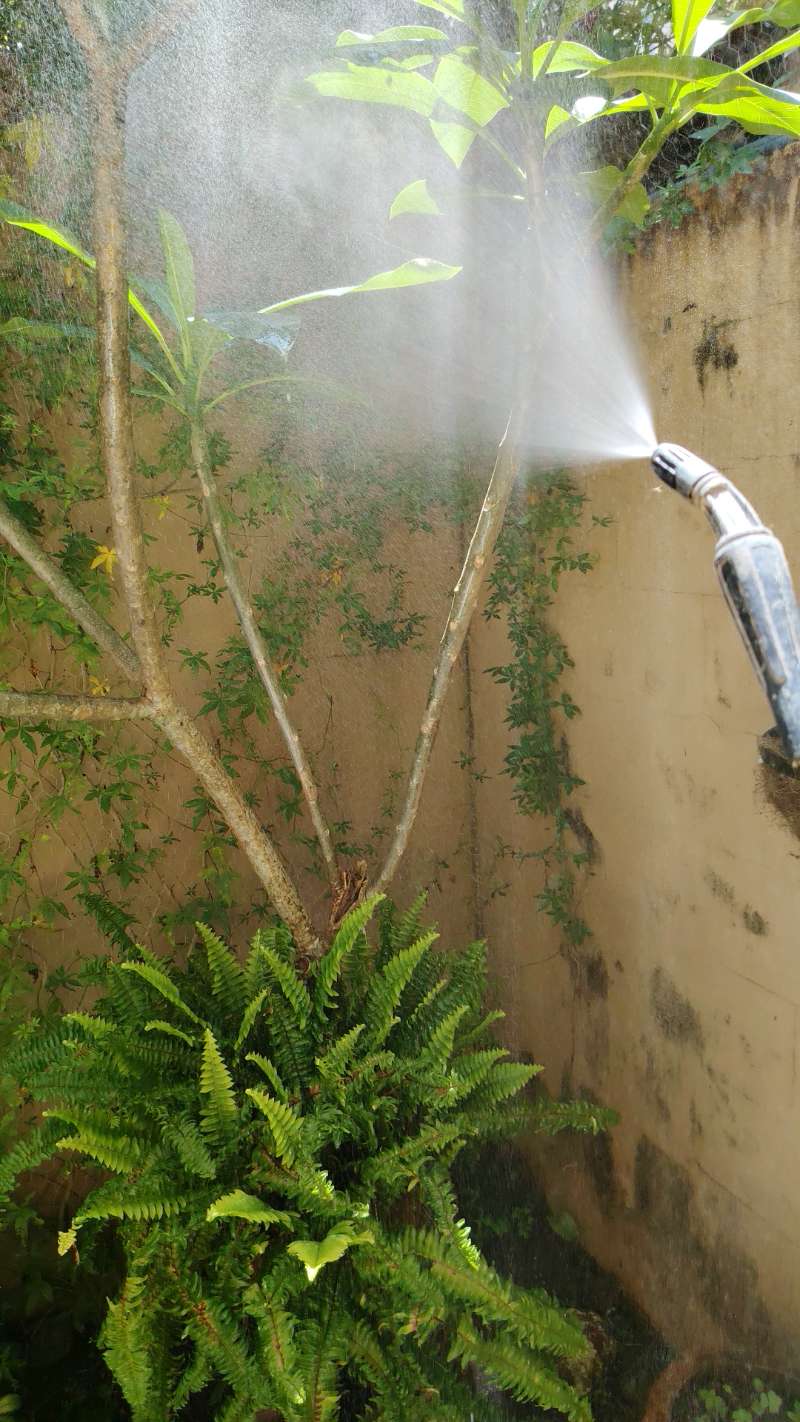
We fog the yard and the resting sites (vegetation, under eaves, around tanks), apply a residual treatment on exterior walls that lasts several weeks, and go over the breeding sites with you. You can go back in one hour later. Service details in mosquito control.
Price: house or apartment up to 100 m² ₡39,900, up to 200 m² ₡49,900, over 200 m² ₡59,900, VAT included, with no travel charge in the Greater Metropolitan Area. Date confirmed in under an hour on WhatsApp. If you have not fumigated in the last 6 months, it takes two applications and the second one is charged; the 30-day check only applies once the plan is complete.
Frequently asked questions
How do I know if the mosquito I saw is the dengue mosquito?
If it's black with clearly marked white stripes on its legs, you saw it during the day and it was inside the house or in the yard near containers with water, it's almost certainly Aedes aegypti. The common nighttime mosquito is brown, has no stripes and comes in from outside at dusk.
Do all Aedes aegypti transmit dengue?
No. Only a female that previously bit a person with the virus in their blood transmits it. That's why in a neighborhood with no cases the mosquito is a nuisance but doesn't make you sick, and in a neighborhood with an outbreak every mosquito is a risk. What you can control is the number of mosquitoes, not which one is infected.
If the Ministry of Health already sprayed the neighborhood, do I need to do anything else?
Yes. The Ministry's spraying kills the adults flying that day. The larvae in the flowerpot saucer are still alive and within a week there are new mosquitoes. Spraying buys time; eliminating breeding sites is what breaks the cycle.
How much does it cost to spray a house for dengue mosquitoes?
₡39,900 for a house or apartment up to 100 m², VAT included and with no travel charge in the Greater Metropolitan Area. Up to 200 m² ₡49,900 and over 200 m² ₡59,900. It includes fogging the yard and resting sites, a residual treatment on exterior walls and a review of breeding sites with you.