
Mosquitoes
Mosquito repellent: which one really works in Costa Rica (and citronella doesn't)
- They work: DEET at 20 to 30 %, picaridin at 20 %, IR3535 and oil of lemon eucalyptus (PMD). The label tells you, not the brand.
- They don't work: citronella candles and bracelets, ultrasonic devices, phone apps and vitamin B.
- Babies under 2 months: a mosquito net, no repellent. Never lemon eucalyptus under age 3.
- The dengue mosquito bites during the day. Repellent helps; eliminating breeding sites at home helps more.
If you're looking for a mosquito repellent that works, here's the short answer: read the active ingredient on the label and buy one that says DEET between 20 and 30 %, picaridin at 20 %, IR3535 or oil of lemon eucalyptus (PMD). Those four are the ones backed by evidence and recommended by the WHO and the CDC. Everything else sold with the word "repellent" offers little or no protection.
Citronella candles or bracelets, ultrasonic devices, phone apps and vitamin B belong to the second group. In Costa Rica, with dengue circulating almost all year and the rainy season from May to November, choosing wrong isn't just wasting money: it leaves your family unprotected during the hours when Aedes aegypti bites.
What the evidence supports
DEET. It's the most studied repellent, with more than 60 years of use. At 20 to 30 % it protects for several hours against mosquitoes, including the dengue mosquito. Higher concentrations extend protection time a little, but above 50 % they add nothing. It has a strong smell and can damage plastics and synthetic fabrics.
Picaridin at 20 %. It protects as well as DEET at that concentration, barely smells, doesn't feel greasy and doesn't damage plastics or clothing. It's the one we recommend most for daily use and for children.
IR3535. Very common in European products and in several formulas for children. It protects for a bit less time than DEET at 30 %, so you need to reapply more often, but it's safe and has a mild smell.
Oil of lemon eucalyptus (PMD). It's the only plant-based repellent with evidence comparable to the synthetics. Watch out for the mix-up: what works is the refined PMD found in products registered as repellents, not the pure lemon eucalyptus essential oil sold in health food stores. Not for use on children under 3.
What doesn't work (and gets sold anyway)
- Citronella candles, coils and torches. Studies that have measured bites around a lit citronella candle find no difference worth mentioning. The smoke bothers a mosquito flying right over it for a while; two meters away it does nothing.
- Repellent bracelets. Whether citronella, essential oils or "technology," they protect the wrist and nothing else. In tests, mosquitoes bite a few centimeters from the bracelet.
- Ultrasonic devices and phone apps. There isn't a single controlled study showing that a sound reduces bites. Mosquitoes don't navigate by ultrasound.
- Vitamin B, garlic or brewer's yeast. Tested on volunteers: mosquitoes bite just the same. What attracts them is carbon dioxide, heat and skin odor; eating something doesn't change that.
- "Natural" repellents with no declared ingredient. If the label doesn't say what it contains and at what percentage, there's no way to know if it protects.
How to apply it properly
A good repellent applied badly only half protects. What works:
- Sunscreen first, then repellent. Wait a few minutes between the two. Avoid products that combine both: sunscreen needs reapplying every 2 hours and repellent doesn't, so you'd end up using too much of one of them.
- Cover all exposed skin with a thin, even layer. Mosquitoes find the little spot without repellent: the ankle, the back of the neck, behind the ear.
- None on children's hands, or near the eyes and mouth. Put it on your own hands and spread it on the child. Not under clothing or on wounds either.
- Reapply according to the label, and sooner if you sweated a lot or got wet. DEET at 25 % or picaridin at 20 % give 5 to 8 hours; IR3535 and PMD, less.
- When you get home, wash with soap and water. Don't sleep with repellent on.
Repellent for babies and children
It's the question we get most often and the one with the most myths.
- Under 2 months: no repellent at all. A mosquito net over the stroller, the crib and the baby carrier, long-sleeved clothing and staying out of the yard at dawn and dusk.
- From 2 months on: the American Academy of Pediatrics accepts DEET up to 30 % from 2 months of age. With picaridin, follow the minimum age on the label; many products set it at 6 months. Just one application a day on young children.
- Oil of lemon eucalyptus (PMD): never before age 3.
- Don't put repellent on a child's hands, because they put them in their mouth. Not on bracelets or patches either, which don't protect.
- When the child comes back inside, wash their skin.
Clothing, timing and the dengue mosquito
Aedes aegypti, which transmits dengue, chikungunya and Zika, bites during the day, with two peaks: the early morning hours and the last hour before dark. It's different from the common nighttime mosquito. That's why dengue repellent goes on when you leave home in the morning, not just at bedtime.
Light-colored, long-sleeved, loose clothing helps: mosquitoes bite through fabric that's tight against the body. In outbreak areas, permethrin-treated clothing (sold in outdoor stores) repels for as long as the treatment lasts and is not applied to the skin.
Inside the house, Aedes rests behind curtains, under beds and in the bathroom. In how to recognize the dengue mosquito we explain the white stripes and the lyre on the thorax.
What protects most: a home without breeding sites
Here's the part that changes the outcome. Repellent protects one person for a few hours. Eliminating breeding sites protects the whole household all the time, because Aedes aegypti doesn't fly more than 100 to 200 meters in its lifetime: the mosquito biting you was almost always born in your yard or your neighbor's.
Once a week, rain or shine: empty and scrub flowerpot saucers, vases and the dog's water bowl; cover tanks, drums and laundry sinks; get tires, buckets and bottle caps out of the yard; clear gutters and make sure no water is left on the car cover or the roof of the shed. Eggs stuck to the container wall survive dry for months, which is why you have to scrub and not just empty. The full list is in dengue in Costa Rica 2026: the breeding sites nobody checks, and preventing pests without chemicals has more home measures that cost nothing.
When to spray
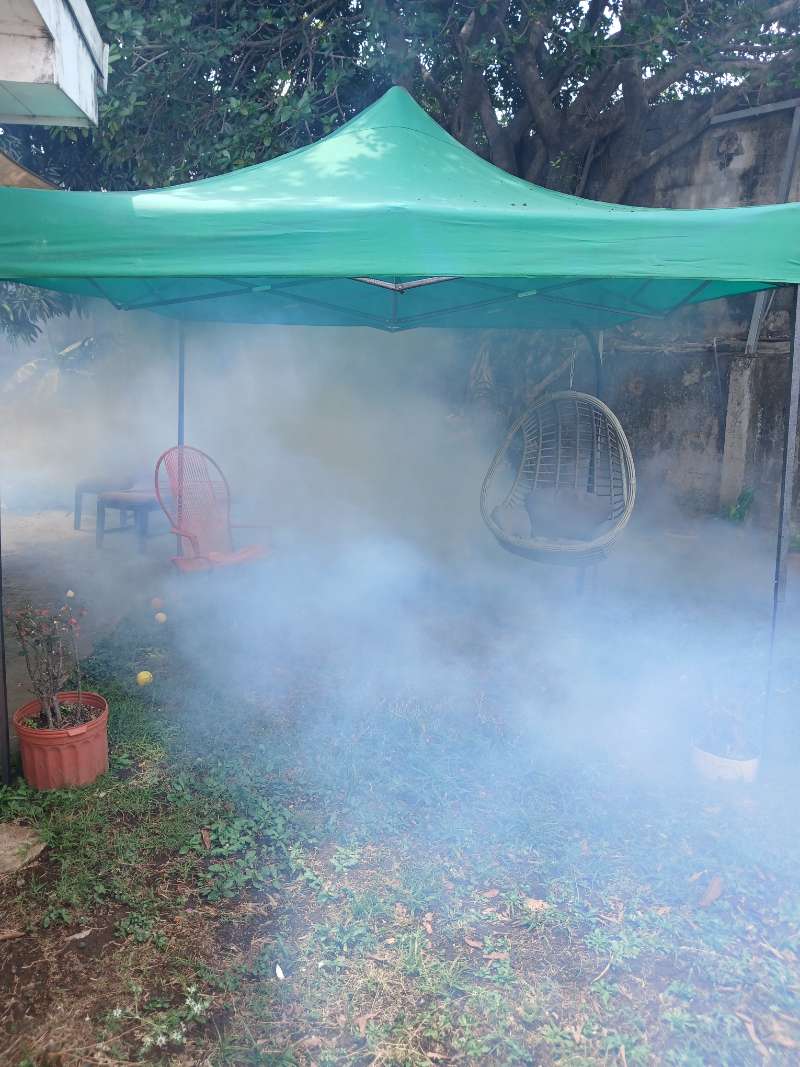
Residential mosquito spraying makes sense in three situations: when there is a dengue outbreak in the neighborhood and vulnerable people live in the house (babies, pregnant women, older adults); when the yard is large or borders a vacant lot, river or coffee field and the number of mosquitoes doesn't drop even though you've already eliminated your breeding sites; and before an outdoor event, such as a wedding or a garden party.
We fog the yard and the places where adults rest (vegetation, under eaves and around tanks), plus a residual treatment on exterior walls that lasts several weeks. It doesn't kill larvae in water: if the breeding sites remain, there are mosquitoes again in two weeks, which is why we pair it with a yard check together with you. Details on the mosquito control page.
How much it costs
House or apartment up to 100 m²: ₡39,900, VAT included, with no travel charge in the Greater Metropolitan Area. Up to 200 m² ₡49,900 and over 200 m² ₡59,900. The date is confirmed in under an hour on WhatsApp, you can go back into the house one hour after the treatment. If you have not fumigated in the last 6 months, it takes two applications and the second one is charged; the 30-day check only applies once the plan is complete.
Frequently asked questions
What is the best mosquito repellent for Costa Rica?
Any whose label says DEET between 20 and 30 %, picaridin at 20 %, IR3535 or oil of lemon eucalyptus (PMD). Among those, the one you tolerate and will actually apply. The brand matters less than the active ingredient and the concentration.
Does citronella work against mosquitoes?
Citronella candles and bracelets don't provide measurable protection. Citronella oil applied to the skin repels for a few minutes and evaporates. If you want something plant-based with evidence, oil of lemon eucalyptus (PMD) is the option, and it's not the same as the pure essential oil.
What repellent can I use on a baby?
Under 2 months: none; use a mosquito net over the stroller and crib and clothing that covers the skin. From 2 months on you can use DEET up to 30 % or picaridin according to the minimum age on the product label. Never lemon eucalyptus before age 3. Put it on your own hand and spread it, without touching the child's hands, eyes or mouth.
If I have my house sprayed, do I still need repellent?
Spraying greatly reduces the number of adult mosquitoes in and around the house for a few weeks, but repellent is still what protects you on the street, at school or at work. They are two different layers.