
Rodents
Rat traps: which work, which don't, and how to set them right
- What works: a snap trap of the right size, an electric trap and the homemade bucket trap. We don't recommend glue traps, and live-catch traps only if you have somewhere to take the animal.
- Flush against the wall, perpendicular, on the route where you find droppings. Bait: peanut butter, not cheese.
- Always wear gloves and check daily. Roof rat in the ceiling every night: set the traps up there, not in the kitchen.
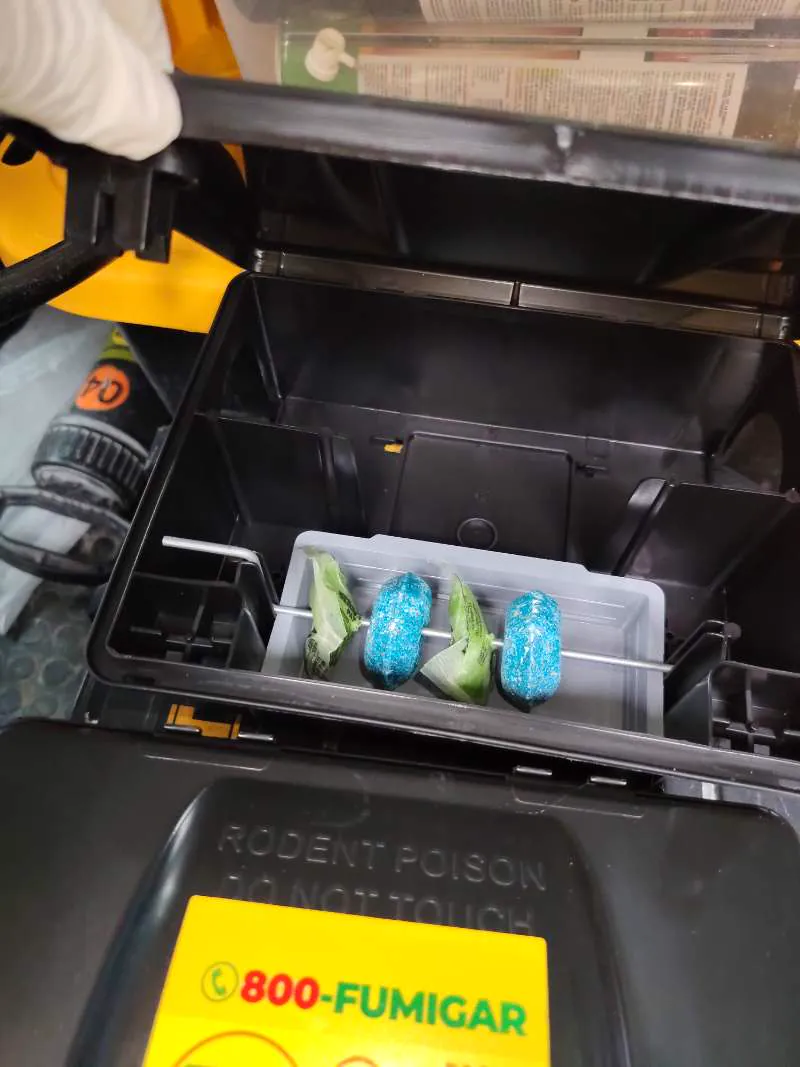
- More than 2 or 3 animals, or noise every night: traps aren't enough. 4 closed bait stations installed, ₡48,900.
If you're looking for a rat trap because you heard noises or found droppings, the short answer is: a snap trap of the right size, baited with peanut butter and set flush against the wall on the animal's route, works. So does the homemade bucket trap. We don't recommend glue traps, live-catch traps only make sense if you have somewhere to take the animal, and ultrasonic devices aren't traps, they're a waste of money.
The second half of the answer matters just as much: traps work for one, two, three animals. If there's noise in the ceiling every night, if droppings show up in several rooms, or if you've been trapping for two weeks and they keep coming, it's no longer a trap problem but a population problem, and what works then is closed bait stations and sealing the entry point. We explain it at the end.
Types of traps: which work and which don't
Snap traps (spring). The classic wooden one or the plastic one with jaws. It kills instantly if the animal goes in right. It's the cheapest and the most effective per colón. Two conditions: it has to be the right size for the animal (a mouse trap won't kill a roof rat, it injures it and makes it wary) and it has to be well placed.
Electric traps. A box with bait inside; the rodent walks in, touches two plates and gets a shock. They work well, with no blood and no risk to your fingers; they cost more and run on batteries.
Live-catch traps (cage). They catch without killing. The problem is what to do next: releasing a roof rat 200 meters away is releasing it on your neighbor, and within 2 kilometers it comes back. If you don't have a real destination for the animal, it's not the right trap.
Glue traps (glue boards). We don't recommend them. The animal stays alive for hours or days, tears its skin trying to break free, and adult rats often pull loose and learn. They catch lizards, birds and the cat's paw.
Ultrasonic devices. They don't catch anything, and rodents get used to the sound within days. We go into detail in ultrasonic mouse repellers: why they don't work.
The homemade bucket trap: the only homemade one we recommend
Of all the homemade rat traps going around in videos, the bucket trap with a ramp is the one that works, and it catches several animals in one night without resetting.
- A 20-liter bucket. If you want a live catch, leave it empty; if you don't want them to survive, add 15 cm of water.
- A roller across the mouth of the bucket: a soda can or a plastic bottle with a wire or rod run through it, resting in two holes in the rim. It must spin freely.
- Peanut butter spread in the middle of the roller.
- A ramp (a board or a ruler) from the floor to the rim of the bucket.
- The animal climbs up, reaches for the peanut butter, the roller spins and it falls in.
Set it where there's activity and check it every morning. Adult roof rats are sometimes wary the first night; leave the roller fixed with bait for two nights, then free it.
Where to set them (where almost everyone goes wrong)
Rodents don't cross the middle of a room. They walk right along the wall, whiskers touching it, always on the same route. So:
- Trap perpendicular to the wall, with the trigger (the bait end) touching the wall. The animal comes by, pokes its head in, and the trap snaps. If you set it parallel or in the middle of the floor, it walks around it.
- On the route, not where it's convenient for you. The route is where you find droppings, grease marks 5 cm above the floor, or tracks in the dust. Behind the stove, under the sink, next to the refrigerator, at the storage room door.
- If the noise is in the ceiling, the traps go in the ceiling. The roof rat comes down to the kitchen when it wants to, but it lives up there. Go up with gloves and a flashlight, look for droppings and set the traps on the beams where it walks, flush against the wall or the beam.
The bait that actually works (and cheese doesn't)
Peanut butter is the universal bait: it smells strong, it sticks to the trigger and they can't take it without setting off the trap. Also chocolate, bread with oil, a small piece of bacon or ripe fruit (roof rats mostly eat fruit and seeds) and, for mice, oats.
Cheese is a cartoon myth: it dries out in hours, has little smell, and they lift a hard piece off without setting off the trap. Amount: the size of a bean, spread on firmly.
A trick we use: bait without setting the trap for the first two nights. Rats are wary of any new object on their route. Once they've eaten the bait twice with nothing happening, set the trap and that night it gets them.
How many, gloves and daily checks
- How many: more than you think. For a mouse, 6 traps in the kitchen; for a rat, 4 to 6 on its route and 2 or 3 in the ceiling. A single trap is a lottery.
- Gloves, always, to set, check and remove traps. Rodent droppings and urine transmit leptospirosis. Double-bag it and throw it out.
- Check daily, in the morning. An animal left dead for 3 days in the ceiling smells for a whole week.
- After removing it, disinfect with diluted bleach and reset the trap in the same spot: the route is still the same. Never sweep up droppings dry.
Roof rat or mouse: the trap and the location change
In homes in the GAM (the Greater Metropolitan Area), what you almost always have is the roof rat (Rattus rattus): a body of 15 to 20 cm plus a tail longer than the body, droppings like a large grain of rice, 1 cm long, with pointed ends; it climbs cables, branches and rough walls and lives in the ceiling. It makes noise at night, between 10 p.m. and 4 a.m. It needs a rat-sized trap, set up there.
The house mouse (Mus musculus) measures 7 to 10 cm, its droppings are 3 to 6 mm, like a chia seed or a small grain of rice, and it lives in the kitchen: behind the refrigerator, inside the drawer where you keep plastic bags, under the sink. It comes out when the lights are off and eats many times a day, a little at a time. It's easily caught in a mouse trap with peanut butter.
More signs to tell them apart in the rodent guide.
When traps aren't enough
Traps are a tool for a few animals. Stop insisting on traps and move to the next level if:
- There's noise in the ceiling every night, in several spots, or you hear it run from one end to the other.
- You've caught 2 or 3 animals and fresh droppings keep appearing.
- There are droppings in several rooms, not just the kitchen.
- You see rodents during the day: a sign that there are many.
- There are fruit trees or palms touching the roof, an empty lot next door, or chickens: the house gets new animals every week.
If you don't want poison in the house in any form, in how to get rid of mice without poison we explain how far traps and sealing can go on their own.
Closed bait stations: what we use and what it costs
For an established population, what works is the closed bait station with rodenticide bait inside: a locked plastic box with two rodent-sized entrances and the bait anchored in the center, where a child, a dog or a cat can't reach it. The rodent goes in, eats and leaves. They're placed numbered and dated along the outside perimeter and the roofline, and after 15 days we check how much bait each one consumed: that's how you know when the problem is over.
About the bait: the Klerat sold at hardware stores is brodifacoum, a second-generation anticoagulant that kills with a single feeding and is just as lethal to dogs and cats. Left loose in a corner, it's a risk that isn't worth it: it only makes sense inside a closed station. We explain it in depth in rat poison: which one, where and how.
4 stations installed: ₡48,900 (CRC), within 24 to 72 hours, with a check at 15 days and sealing of the main entry point. 8 stations: ₡79,900 for large houses or lots with fruit trees. And if you'd rather do it yourself, the same station our technicians install is sold in the site's store, with bait included and delivery, from ₡39,000 for the pack of 4. Date confirmed in less than an hour on WhatsApp.
Frequently asked questions
What is the best rat trap?
For a small problem, a rat-sized snap trap baited with peanut butter, set flush against the wall on the animal's route. An electric trap does the same with less risk to your fingers, but it costs more. For several animals, the homemade bucket trap catches several in one night.
Do homemade rat traps work?
The bucket trap with a ramp and roller does, and it's the only homemade one we recommend. Bottle traps and box-and-stick traps sometimes catch small mice; with roof rats, almost never. Remedies with pepper, mint, lime or homemade poison don't work.
What bait do rats actually go for?
Peanut butter, chocolate, bread with oil, a small piece of bacon or ripe fruit. A little, the size of a bean, stuck firmly to the trigger. Cheese is a cartoon thing: it dries out, has little smell and they take it without setting off the trap.
Can I put out Klerat or hardware store bait without a station?
We don't recommend it. Klerat is brodifacoum, a single-feeding anticoagulant: what kills the rat kills the dog and the cat and puts a child at risk. If you're going to use bait, it must go inside a locked, closed station. The station our technicians use is sold in the site's store.