
Rodents
How to Get Rid of Rats at Home for Good (and Why They Come Back)
- Rats come back because the entry point is still open: a roof rat only needs a 2 cm (under 1 inch) gap.
- Today: remove food and water, close up the trash, check the ceiling space with a flashlight.
- Snap traps work if they sit flush against the wall, with a small amount of bait and in numbers (6 to 10).
- Loose poison, ultrasonic devices and home remedies solve nothing, and the first one is a hazard.
- 4 closed bait stations installed: ₡48,900 (CRC), within 24 to 72 hours, with a follow-up check at 15 days.
Why rats come back even after you kill them
The rat running across the ceiling at night in Costa Rica is almost always the roof rat. It lives up high, not on the ground. It gets in through a shifted roof tile, through the gap where the downspout meets the wall, along the power or phone cable, and over any branch that touches the roof. A gap of 2 cm, about the width of a thumb, is all it needs.
If you kill the ones inside and leave the entry open, within a few weeks another family moves in the same way: the path is marked with urine and works as a guide for them. That is why "for good" does not mean a stronger trap or a more expensive poison. It means killing the ones you have and closing the way they got in. The second part is what almost nobody does, and it is the reason most people who search "how to get rid of rats fast" end up searching it again three months later.
How to tell rats from mice
- The sound of running in the ceiling at night, especially between 9 p.m. and 4 a.m.
- Droppings 1 to 2 cm long with pointed ends. Mouse droppings look like a grain of rice.
- Dark, greasy marks on the wall next to beams or pipes, where they always pass.
- Bitten fruit on the backyard tree: mango, avocado, papaya, orange.
- Chewed wires, torn pipe insulation, a bag of dog food with a hole in it.
If you are not sure, signs of rats and mice covers the differences in detail. It matters because a house mouse problem takes fewer traps placed on the floor; the roof rat means working up high.
What you can do today
- Remove food and water. Dog and cat food in a container with a lid, fruit out of the open fruit bowl, dishes washed before bed. Dry the sink, fix the dripping faucet, don't leave buckets of water out.
- Close up the trash with a lid and take it out at night to the outdoor bin, which should also have a lid.
- Check the ceiling space with a flashlight: droppings, clean paths in the dust, chewed cardboard or insulation. Mark where there is the most. That is where the traps go.
- Trim the branches that touch the roof. They are the most used bridge.
- Look at the roof from outside at dawn: lifted tiles, gaps along the ridge, the opening where the cable comes in.
None of this kills a rat, but without it no trap or bait works: a rat prefers the food it already knows.
Snap traps: where, what bait and how many
The snap trap (the spring kind, in wood or plastic) is the home method that actually works on rats, with three conditions.
Where. Flush against the wall with the trigger facing the wall, because rats run along the edges. In the ceiling space, on the beams where you found droppings. Downstairs, behind the fridge, under the sink, next to the gas tank.
Bait. A dab of peanut butter the size of a bean, pressed firmly onto the trigger. A small piece of sausage or ripe fruit tied on with thread also works. Use very little: if you put on a lot, the rat eats it without setting off the trap.
How many. More than you think. For a house with one family of rats, 6 to 10 traps on the same night. Two traps are not enough: the roof rat is wary and learns fast.
A trick that changes the result: leave the traps baited and unset for two or three nights. Once you see the bait being eaten, set them all on the same night. Check them every morning with gloves, dispose of the animal in a double bag and rebait. If after a week you stop catching any, either there are none left or the ones still there have learned to stay away. In the second case, home methods have reached their limit.
Loose poison, ultrasonic devices and remedies that don't work
Poison pellets or blocks left loose around the house have two problems. The rat eats, goes off to die inside the wall or in the attic space, and the smell lasts two or three weeks with no way to get it out. And the bait stays within reach of children, dogs, cats and chickens. If you are going to use bait, it has to go inside a closed station. In rat poison we explain which products exist and what the label says.
Ultrasonic repellers have no independent evidence that they drive rats away. Rats get used to them within days, and the sound does not go through walls or ceilings. Home remedies (pepper, mothballs, mint, camphor, garlic) may bother them for a couple of days; with food and shelter available, the rat stays. Many people search "how to keep rats away". The honest answer is that you don't keep them away: you eliminate them and block their way in.
Sealing the house: mesh and foam
This is the "for good" part. With the flashlight and what you saw from outside:
- Gaps up to 5 cm (2 inches): pack them tightly with steel wool (the kind for scrubbing pots, or galvanized mesh) and cover with polyurethane foam or cement. Without the mesh, a rat chews through the foam in one night.
- Where pipes and cables pass through the wall: mesh and sealant.
- Gap under exterior doors: brush door sweep or a metal strip.
- Roof tiles: line them up and put mesh along the ridge and in open eaves.
- Trees: branches at least 1.5 meters (about 5 feet) from the roof.
- Downspouts: a mesh over the top opening.
Do this after trapping the ones inside, or you will seal live rats into the ceiling. The details, material by material, are in how to seal your home.
Closed bait stations: how EcoPlagas does it
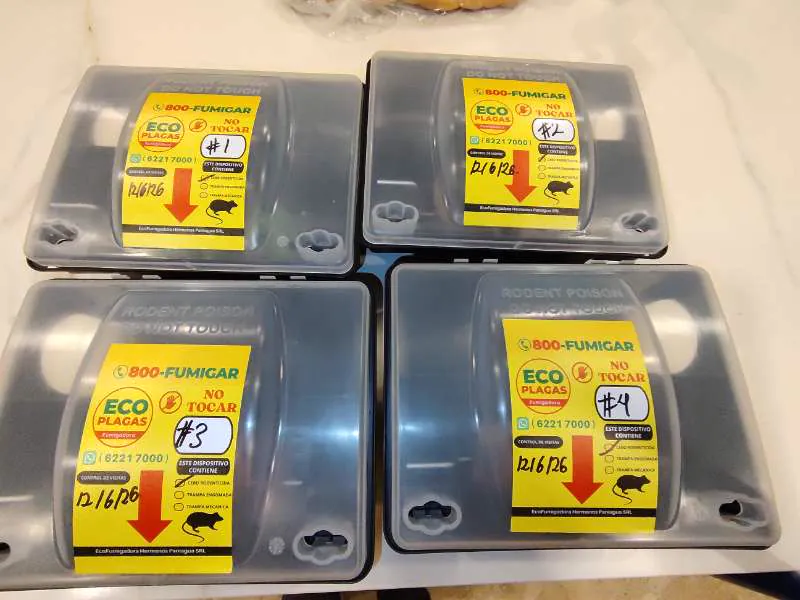
When there are more than a couple of rats, the ceiling space is not accessible or the problem has gone on for months, what works is installing closed bait stations: hard plastic boxes with a lock, bait inside, anchored, numbered and dated. They go along the outside perimeter and along the roofline where the rat travels. The rat goes in, eats and returns to its nest; the bait is never left loose. The technician finds the main entry point and shows it to you so you can close it. At 15 days we check which stations had bait eaten: that tells us where they move and when the problem is over. The full service is on rodent control.
Installation is within 24 to 72 hours, with a date confirmed in less than an hour by WhatsApp. Service 24 hours a day, every day, nationwide. You can go back into the house one hour later. If you have not fumigated in the last 6 months, it takes two applications and the second one is charged; the 30-day check only applies once the plan is complete. EcoPlagas is authorized by the Ministry of Health.
How much it costs
4 stations installed: ₡48,900. 8 stations, for a large house or a lot with a fruit tree: ₡79,900. A single visit, 15-day follow-up check included. Prices on the prices page. Phone 6073-1000, WhatsApp 6030-0045.
Frequently asked questions
How long does it take for rats to go away with bait stations?
The bait starts being eaten in the first few days and activity drops within one to two weeks. The check at 15 days confirms whether any station is still active.
Why did the rats come back after I killed them?
Because the entry point stayed open and the urine trail guides new ones in. You have to seal with mesh and foam after eliminating the ones inside.
Do snap traps work for roof rats?
Yes, if they sit flush against the wall, on the ceiling beams, with a small amount of bait and in numbers. It helps to bait them unset for two nights before setting them.
Are bait stations safe with children and pets?
Yes. The bait goes inside a locked, anchored station that is out of reach. No poison is left loose.