
Diagnosis · Scorpions
Scorpion species in Costa Rica: which ones live in homes and how dangerous they are
- In homes in the Greater Metropolitan Area, the scorpion that shows up is almost always a yellowish brown one from the genus Centruroides, with slender pincers and a thin tail.
- Its sting hurts a lot and causes numbness, but it's rarely serious; in Costa Rica it's not an emergency like in Mexico.
- The big black scorpions of rural areas are scarier and sting less: thick pincers mean weak venom.
- The vinegaroon (whip scorpion) has no venom. And the myth that "the smaller, the more venomous" is false.
Costa Rica has about 15 species of scorpions, but in a home in the Greater Metropolitan Area the one you'll find in your shoe, behind a picture frame or dropping from the ceiling is almost always the same: a yellowish brown scorpion, 5 to 8 cm long, with slender pincers and a thin tail, from the genus Centruroides. It stings, it hurts a lot, and in the vast majority of cases that's as far as it goes. The big black scorpions of rural and coastal areas are another family, with thick pincers and weaker venom. And what many people call a "whip-tailed scorpion" is the vinegaroon, which is neither a scorpion nor venomous.
Below: how to recognize each one, where it hides, why size says nothing about venom, and how they're found and controlled.
Brown house scorpions (Centruroides): the ones in the Greater Metropolitan Area
How to recognize them. Light brown or yellowish, sometimes with two darker bands along the body. Between 5 and 8 cm with the tail extended. Slender, elongated pincers, and a long, thin tail kept curled over the body. They're good climbers: that's why they're on walls, ceilings and boxes, not just on the floor. There are several species of the genus in the country; the ones in homes in the Central Valley are among the least toxic, and the dark-banded one from the Pacific (Centruroides bicolor) is the one that causes stronger reactions.
Where they live in the house. In dry, dark places: ceilings (the number one spot in houses with a zinc roof and a wood-plank or drywall ceiling), behind picture frames and mirrors, among hanging clothes, in shoes, in cardboard boxes, in curtain folds, under washing machines, in the laundry room, in the hollows of concrete blocks. They come in looking for insects to eat (cockroaches, crickets, spiders) and for shelter when the yard floods in the rainy season or gets too dry in March and April.
What risk they pose. The sting causes intense, immediate pain, like a burn, with tingling and numbness that can spread through the limb for hours. Severe reactions (difficulty breathing, heart rhythm disturbances) are uncommon in Costa Rica and occur mostly in young children. With a child under 5 or with symptoms beyond local pain, go to a health center. Step by step in scorpion sting: what to do.
How they're controlled. Residual treatment of the ceiling, the indoor cracks and the outside perimeter, reducing the cockroaches and crickets they feed on, and sealing entry points. Details on the scorpion control page.
Big black rural scorpions: scarier, but they sting less
How to recognize them. Black or very dark brown, sturdy, with thick, wide pincers like a crab's, and a short tail relative to the body. They can exceed 8 cm and look heavy. They move slowly. In Costa Rica they belong to the families Diplocentridae (such as Didymocentrus) and Hormuridae, typical of forests, farms and the Caribbean and southern Pacific.
Where they live. Under logs, stones and leaf litter, in burrows in the ground. They get into farmhouses, cabins and country homes in rural areas, especially in firewood stacked against the wall and in tool sheds. In the Greater Metropolitan Area they're rarely seen.
What risk they pose. Low. Their hunting strategy is to crush prey with their pincers, not poison it, so their venom is weak. The sting hurts like a wasp sting and goes away within hours. The general rule for scorpions: thick pincers and a short tail, weak venom; thin pincers and a long tail, strong venom.
The vinegaroon or whip scorpion: looks like a scorpion, but isn't
How to recognize it. Black, flattened, 4 to 7 cm, with thick pincers facing forward and, instead of a tail with a stinger, a thin filament like a long hair (the "whip"). It walks on six legs and uses the first pair, very long and thin, as antennae. It belongs to the order Thelyphonida, a distant relative of scorpions and spiders.
Where it lives. Under stones and logs, in damp soil, sometimes in gardens and garages of homes with lots of greenery. It comes out at night.
What risk it poses. None in terms of venom: it has no stinger or venom glands. If it's grabbed, it sprays acetic acid from the base of the whip that smells like vinegar (hence the name) and can irritate the eyes. It eats cockroaches and crickets. The right thing to do is to put it out in the garden.
The myth: "the smaller, the more venomous"
It's false, and it comes from a mix-up. The small scorpions that show up in homes are usually juvenile Centruroides, the same species as the 6 cm brown adult. They do sting and their venom is the same, but they inject less of it than an adult. What determines how dangerous a scorpion is isn't its size but its species, and the species shows in its shape: slender pincers and a thin tail (family Buthidae, which includes Centruroides) are the ones with active venom; thick pincers and a short tail are the ones with weak venom, even if they measure 10 cm.
Another belief: that "they come in pairs." What is true is that if you found one inside, there's a population outside or in the ceiling, and that a female carries 20 to 40 young on her back for the first few weeks. Seeing several small ones at once means a female gave birth nearby.
How to find them: the UV flashlight
The cuticle of all scorpions glows bluish green under ultraviolet light. A cheap UV flashlight (the kind used to check banknotes works) makes a nighttime search easy: turn off the lights and go over the laundry room, the garage, the edges of the exterior walls, the grass next to the house and, carefully, the attic. Wherever there's one, you'll see it from meters away. Do it on a night in the rainy season, when they move around most, and you'll know whether you have two or twenty.
Prevention: where they hide and how to keep them out
- Shake out shoes and clothes that were on the floor or in the storage room before putting them on: that's where most stings happen.
- No cardboard boxes in storage rooms: plastic containers with lids.
- Firewood, blocks and roof tiles away from the walls of the house.
- Seal the gaps around pipes and cables and the joint between ceiling and wall with silicone. Rubber door sweeps under exterior doors.
- Fine mesh on the attic vents.
- Control cockroaches and crickets: without food, scorpions leave.
- Check the ceiling with the UV flashlight after the first heavy rains in May and in March, when the heat gets them moving.
The complete guide is in scorpions at home: why they come in and how to prevent them.
How they're controlled
Professional treatment works on three fronts: the ceiling, with a residual application on the wood planks or drywall and at the joints with the walls, which is where they live and where they fall from; the indoor cracks (frames, baseboards, closets, laundry room, storage room) and the outside perimeter, with a residual band at the base of the walls, the meters and the blocks. And since scorpions eat insects, the same treatment reduces the cockroaches and crickets that brought them in.
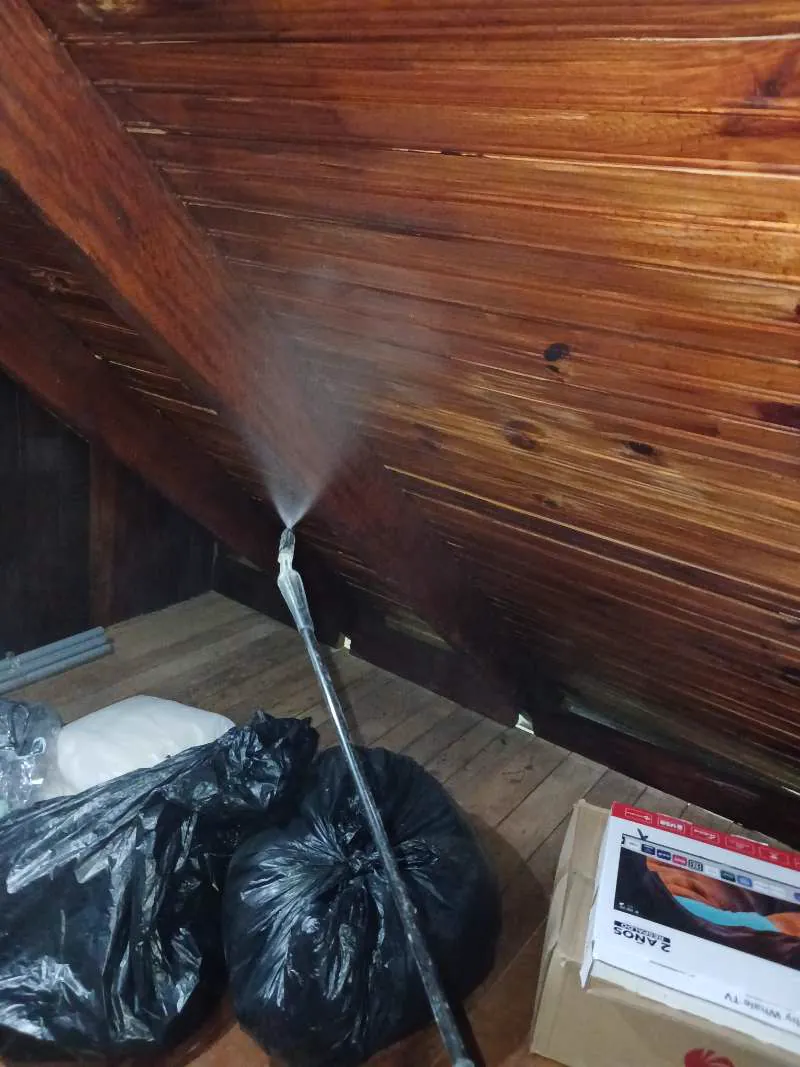
Scorpions are tougher than cockroaches and walk over treated surfaces without dying right away. That's why the residual goes where they hide, not where they walk, and sealing and controlling their food matter as much as the product.
What it costs and when to call
Call if you found more than one inside in a month, if you saw young, if you have small children or if you saw several in the ceiling or around the perimeter with the UV flashlight. Scorpion treatment is part of the common household pest service: up to 100 m² ₡39,900, up to 200 m² ₡49,900, over 200 m² ₡59,900, VAT included, with no travel charge in the Greater Metropolitan Area. You can go back in one hour later. If you have not fumigated in the last 6 months, it takes two applications and the second one is charged; the 30-day check only applies once the plan is complete. Date confirmed in under an hour on WhatsApp.
Frequently asked questions
Which scorpion shows up in homes in the Greater Metropolitan Area?
Almost always a yellowish brown one from the genus Centruroides, 5 to 8 cm long, with slender pincers and a thin tail. It lives in the ceiling, behind picture frames, in shoes and boxes. Its sting hurts a lot and is rarely serious.
Is it true that small scorpions are more venomous?
No. The small ones in homes are usually juveniles of the same species as the adult. What indicates the venom is the shape: thin pincers and a long tail, active venom; thick pincers and a short tail, weak venom.
Is the whip-tailed scorpion dangerous?
It's not a scorpion and has no venom. It's the vinegaroon: instead of a stinger it has a thin filament and, if grabbed, it sprays a liquid that smells like vinegar. Put it out in the garden.
How do I know if I have a lot of scorpions in the house?
With a UV flashlight at night: they glow bluish green. Go over the laundry room, the garage, the outside edges of the walls and the attic. If you see several, the ceiling and the perimeter need to be treated.