Cleaning
How Cleaning Prevents Pests at Home

“But my house is clean” is what we hear most when somebody finds cockroaches. And it is usually true: the house is clean where you can see. The problem is that the cleaning which prevents pests is not the same as the cleaning that looks good. An immaculate worktop with built-up grease behind the cooker is a house with food available. What follows is where to put the effort so cleaning pays off in pest control, and where it is time wasted.
- Built-up grease feeds more than crumbs: it is calorie-dense and it does not evaporate.
- All eight critical spots are out of sight: behind and underneath appliances.
- Sweeping lifts particles; vacuuming removes eggs and larvae. Against fleas that difference decides the outcome.
- The bin matters less than the floor underneath the bin.
- Hygiene reduces and prevents, but it will not clear a colony already established inside the structure.
What a household pest actually eats
It is worth recalibrating the idea of “food”. To a cockroach, food is almost anything organic:
- Grease splashed behind the cooker and in the extractor hood. It is the most valuable thing available: a lot of energy in little volume, and it does not dry out.
- Crumbs in table grooves and under the toaster.
- Residue in the sink drain and in the waste disposal trap.
- Pet food left out overnight. It is the most constant source and the most overlooked.
- Cardboard and damp paper, the glue on boxes, soap, toothpaste.
That last point explains why they turn up in bathrooms where “there is no food”: for them, there is.
The eight spots almost nobody cleans
- Behind and under the cooker. Years of grease. This is number one.
- Under the fridge and its rear coils, where there is warmth too.
- The microwave motor housing and the surface it stands on.
- The gap between cooker and unit, that finger of space where everything falls.
- Inside the unit under the sink, corners and back included.
- The toaster crumb tray, which in many homes has never been emptied.
- The floor under the bin, where liquid has run and nobody looks.
- The sliding door track and the patio door frame.
If you are only going to do three, do 1, 5 and 7.
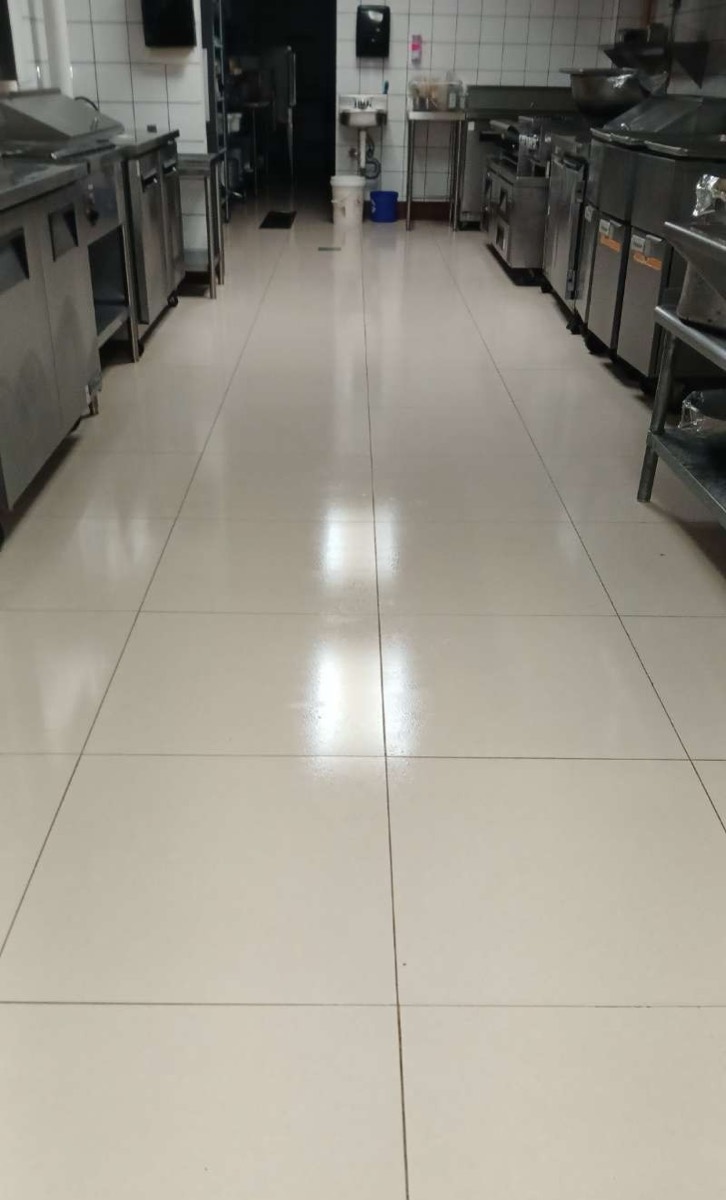
Sweeping, mopping and vacuuming are not the same
- Sweeping raises dust and particles, and with fleas it can scatter eggs. It is fine for coarse debris.
- Vacuuming is superior at almost everything: it lifts eggs, larvae and droppings out of fibres and grooves. Against fleas it is the highest-impact non-chemical measure.
- Mopping with soap removes ant pheromone trails and dissolves grease. One caveat: after a treatment, do not mop the skirting boards for the days you were told — that is exactly where the product was placed.
After vacuuming, take the bag out of the house. If it is bagless, empty the canister outside and rinse it.
The routine that works, by frequency
You do not need to clean everything every day. You need certain things not to build up.
- Daily: dishes washed before bed (or at least in soapy water, not left dry with residue); pet food lifted overnight; sponge wrung out and hung; kitchen bin emptied.
- Weekly: vacuum under furniture and along skirtings; clean the unit under the sink; wash the bin inside and the floor beneath it; check the pantry for moths and weevils.
- Monthly: pull out the cooker and the fridge and clean behind; clean the extractor hood; check the back of the larder.
- Quarterly: empty the pantry completely and check package by package.

Where cleaning stops working
It is important to be honest about this, because it causes unnecessary frustration and guilt.
Hygiene prevents a pest from settling in and limits how large it can get. What it does not do is eliminate a colony already living inside a wall, a ceiling void or a fitted unit. A German cockroach established behind the fridge motor has warmth, condensation water and enough residue: it can sustain itself in a kitchen cleaned every day.
Signs you have crossed that line: seeing them in daylight, finding clustered droppings — black specks like pepper — in drawer corners, or finding oothecae. At that point targeted treatment is needed; cleaning becomes the complement that stops it coming back.
Walk into the kitchen in the small hours and switch the light on suddenly. If you see movement heading for the cracks, there is already an established population and it is not a matter of cleaning harder. If you see nothing on three separate nights, your hygiene is doing its job.
Need professional help?
Call us or message us on WhatsApp. We serve the Greater Metropolitan Area.