
Rodents
Rat or mouse droppings: how to recognize them, what risk they pose and how to clean them up
- Mouse: 3 to 6 mm, pointed, like dark rice. Roof rat: 1 to 1.5 cm, pointed. Norway rat: thicker, with blunt ends.
- Fresh droppings are dark, shiny and soft; old ones are gray, dull and crumble. If there are both, activity is ongoing.
- In Costa Rica, the risks that matter are leptospirosis and salmonella. Never sweep or vacuum dry: it stirs up contaminated dust.
- Cleanup: gloves, 10 % bleach for ten minutes, paper towel, double bag, wash your hands. Then seal up and install stations: 4 stations ₡48,900.
The short answer
If you found dark pellets 3 to 6 millimeters long, with pointed ends, like burnt rice, they're mouse droppings. If they're 1 to 1.5 centimeters and also pointed, it's a roof rat, the one that makes noise in the ceiling. If they're just as long but thicker, like a capsule with blunt ends, it's a Norway rat (sewer rat). Any of the three means rodents are getting into or living in the house, and the amount and condition of the droppings tell you how many and since when.
The most important thing before going on: don't sweep or vacuum them dry. The correct procedure is below; it takes ten minutes and avoids the real risk involved.
Shape and size by rodent
The three species that get into homes in Costa Rica leave different droppings, and that's the most reliable way to know which one you're dealing with:
- House mouse (Mus musculus): 3 to 6 mm, thin, with pointed ends. It looks like a grain of dark rice. It's scattered along its route, in drawers, the pantry and behind the stove.
- Roof rat (Rattus rattus): 1 to 1.5 cm, spindle-shaped, curved, with pointed ends. It's the most common in homes in the Greater Metropolitan Area: it climbs cables, trees and roof tiles and lives in the ceiling. Its droppings are scattered along beams and at the edges of the ceiling.
- Norway rat (Rattus norvegicus): 1.5 to 2 cm, thick, with blunt ends like a capsule. It lives at ground level, in sewers, yards with garbage, storage rooms and garages, and leaves its droppings in groups in the same corner.
Fresh or old, and how many rodents that means
Fresh droppings (less than two or three days old) are black or very dark brown, shiny, and soft if you press them with a stick. Old ones are gray, dull, dusty and crumble. If there are both in the same place, they've been passing through for weeks and are still active. Simple test: clean the area one day and check the next; if there are new droppings, they're there tonight.
To estimate how many there are: a mouse leaves 50 to 80 pellets a day and a rat 30 to 50 larger ones. A handful in a corner of the pantry can be one or two recent mice. Fresh droppings in three or four different rooms, or a continuous layer on top of the ceiling, is already a population breeding inside: a pair of mice reaches 30 or 40 in three months, and roof rats live in family groups, it's almost never just one.
Where you find them in a Costa Rican home
- Ceiling and attic: the roof rat leaves its droppings scattered over the ceiling panels and along the edges, next to nests of paper and insulation. It's what falls down when you remove a panel.
- Behind and under the stove and refrigerator: warm, dark, with food scraps. A favorite spot for mice.
- Pantry and cupboard: in the corner of the drawer, on bags of rice and pet food. That's also where you'll find gnawed food.
- Garage, storage room and laundry room: between boxes, in feed sacks and in the engines of cars that sit for weeks without moving.
- Base of exterior walls and planters: a sign of the Norway rat, with burrows that have 5 to 8 cm entrances.
What it gets confused with
Many of the photos people send us on WhatsApp aren't from rodents. These are the typical mix-ups:
- American cockroach droppings (the big one from the drain): cylinders about 2 mm long, with ridges running lengthwise and blunt-cut ends, not pointed. Half the size of mouse droppings. They show up in bathrooms and near drains.
- Lizard or gecko droppings: a dark cylinder 5 to 10 mm long with a white tip (uric acid) at one end. They show up under lamps, on window frames and on walls. These are the ones most often mistaken for mouse droppings, and they're harmless.
The other signs (noises, grease marks, gnawing, smell) are in the guide to signs of rats and mice in the house.
The real risks in Costa Rica
No alarmism: droppings don't make you sick by looking at them. The risk lies in handling them wrong and in food that rodents have touched.
- Leptospirosis. The rodent-borne disease that does occur in Costa Rica, with more cases in the rainy season. It's transmitted mainly through urine, which accompanies droppings on every surface they pass over, and it enters through cuts, eyes or mouth. That's why gloves aren't optional.
- Salmonella. Through food or utensils contaminated with feces. Throw out any open package with signs of rodents and wash the dishes from the affected cupboard with hot water and soap.
- Hantavirus. It's transmitted by inhaling dust from dried droppings and urine. In Costa Rica it's very rare, but it's the underlying reason not to sweep or vacuum dry.
- Allergies and asthma. Dried mouse urine is a respiratory allergen, important for children who sleep under a ceiling with activity.
How to clean up properly, step by step
- Air out the room for 20 to 30 minutes before you start.
- Put on rubber or nitrile gloves. If there are a lot of droppings or they're in the ceiling, also an N95 mask and glasses.
- Don't sweep or vacuum dry.
- Spray 10 % bleach (one part bleach to nine parts water) on the droppings and urine stains until soaked. Wait ten minutes.
- Pick up with paper towels and put everything in a plastic bag; close that bag and put it inside another: a double bag. Into a closed outdoor trash can.
- Clean the surface again with the disinfectant; on floors, a mop with bleach. Fabrics and exposed clothing in the washing machine with hot water.
- Disinfect the gloves before taking them off, throw them away and wash your hands with soap and water.
If the droppings are in the attic and there are a lot, or there are dead animals, it's best to have trained staff with equipment do it. We check it while installing the stations.
What to do after cleaning up
Cleaning without blocking their way in means cleaning again next week. The order that works:
- Remove the food. Rice, beans, cereal and pet food in containers with hard lids. A closed trash can and the garbage taken out every night.
- Seal where they get in. A mouse gets through a 6 mm hole (the width of a pencil) and a rat through 2 cm. Check under doors, pipe and cable openings, the joints between roof and wall and the ceiling vents. Branches touching the roof are the roof rat's bridge.
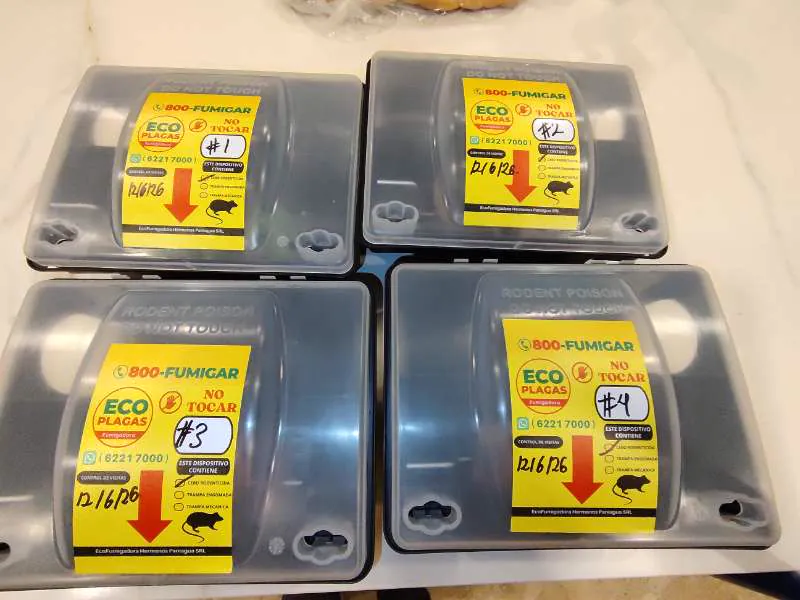
- Closed bait stations along the route the droppings revealed: outside perimeter, roof line and the indoor spots with activity. The bait goes in a locked box, out of reach of children and pets. No loose poison and no glue traps; the difference is explained in how to get rid of rats at home for good.
- A check after 15 days: which stations had bait eaten tells you where they're moving and when the problem is over.
What it costs
4 closed stations installed within 24 to 72 hours, with a check after 15 days: ₡48,900 with VAT. 8 stations, for large houses, lots with fruit trees or activity on several fronts: ₡79,900. No travel charge in the Greater Metropolitan Area. The date is confirmed on WhatsApp in under an hour. The whole procedure is on the rat and mouse control page.
Frequently asked questions
How do I know if droppings are from a rat or a mouse?
By size. Mouse droppings are 3 to 6 mm, like a dark grain of rice with pointed ends. Roof rat droppings are 1 to 1.5 cm, also pointed, and Norway rat droppings are just as long but thicker with rounded ends. If it's the size of a grain of rice, it's a mouse; if it looks like a bean or bigger, it's a rat.
What diseases do rat droppings cause in Costa Rica?
The one that matters most is leptospirosis, transmitted mainly through urine, and salmonella from food contaminated with feces. Hantavirus exists but is very rare in the country. The real risk lies in handling or sweeping dry droppings without protection and in eating something rodents have touched.
Can I vacuum mouse droppings?
No, and don't sweep them dry either. Both stir up fine dust with dried urine and feces and put it into the air you breathe. First soak them with 10 % bleach and leave it for ten minutes; then pick them up with paper towels and throw them away in a double bag.
How much does rat and mouse control cost?
4 closed bait stations, installed within 24 to 72 hours: ₡48,900 with VAT, with a check after 15 days. 8 stations, for large houses or lots with fruit trees: ₡79,900. No travel charge in the Greater Metropolitan Area.