
Diagnosis · Spiders
Spider species in Costa Rica: which ones are dangerous and which aren't
- Of the spiders that get into homes in Costa Rica, only two have venom that matters: the black widow (and its cousin the brown widow) and the recluse or violin spider.
- The banana spider is serious but rare in homes in the Greater Metropolitan Area; the tarantula is scary and its bite is mild.
- Jumping spiders, wolf spiders and the long-legged cellar spiders in the corners are harmless and eat other insects.
- Control isn't "killing spiders": it's removing webs, reducing the insects they feed on and sealing the house.
Costa Rica has hundreds of spider species and almost all of them are harmless to people. At home, the ones you really need to recognize are two: the black widow (and the brown widow, of the same genus) and the recluse or violin spider. The banana spider is dangerous but rare inside a house. The others you see often (the jumping spider, the wolf spider, the long-legged one in the corners and the tarantula) are more or less impressive, and none of them poses a serious risk.
Below is each one: how to recognize it, where it gets into the house, what happens if it bites and how it's controlled.
Black widow and brown widow (Latrodectus): the hourglass spider
How to recognize it. The female has a body 1 to 1.5 cm long, round and shiny, with thin legs. The black widow is black with a red hourglass-shaped mark under the abdomen. The brown widow (Latrodectus geometricus), the most common in urban areas of Costa Rica, is brown or gray with patterns and an orange hourglass. Its egg sacs are little balls with points, like spines: the easiest sign to recognize.
Where it lives. In dark, undisturbed, low corners: water and electric meters, garden furniture, under plastic chairs, utility boxes, storage rooms, garage corners, hollows in concrete blocks. It spins an irregular, strong web, not the classic round one. It's almost never in the living room or bedroom.
What risk it poses. Its venom acts on the nerves: the bite barely hurts at first, and within an hour strong cramps, abdominal pain and sweating appear. It's rarely fatal, but it needs medical attention, especially in children and older adults. The brown widow bites less and its venom is less potent, but the symptoms are the same.
How it's controlled. Inspect and clean the places where it settles while wearing gloves, destroy the egg sacs, apply a residual to meters, garden furniture, blocks and the perimeter, and reduce the insect populations it feeds on.
Recluse or violin spider (Loxosceles): uncommon, but the most treacherous
How to recognize it. Uniform brown, body 0.7 to 1.2 cm, long thin legs, no striking patterns. It has a darker violin-shaped mark on the top of its body and, unlike almost all spiders, six eyes in three pairs instead of eight. It's shy and slow.
Where it lives. In things that don't get moved: stored cardboard boxes, clothes that have been in the closet for months, shoes in storage, behind furniture pushed against the wall. In Costa Rica it's uncommon, and most of the "recluses" people report are other harmless brown spiders.
What risk it poses. Its venom destroys tissue. The bite can go unnoticed, and in one or two days it forms a lesion that darkens and can ulcerate; it needs medical attention because it's slow to heal. It almost only bites when trapped against the skin, which is why most cases happen when putting on stored clothes or shoes.
How it's controlled. Organize the storage room: stored items in closed plastic containers, shake out clothes and shoes before using them, and a residual in storage rooms and rarely used closets.
Banana spider (Phoneutria): serious, but more of a farm spider than a house spider
How to recognize it. Large and hairy: body 3 to 4 cm and a leg span of 12 to 15 cm, brown with a darker underside. When it feels threatened it stands on its hind legs, raises its front legs and shows its fangs. It doesn't spin a web to hunt; it roams at night.
Where it lives. Warm, humid areas: banana and plantain plants, leaf litter, logs, farm sheds. It reaches homes in rural areas inside bunches of bananas, in firewood or in fruit boxes. In a home in the Greater Metropolitan Area it's rare.
What risk it poses. A very painful bite; the venom can cause sweating, a faster pulse and general malaise. Severe cases are uncommon with the species found in Costa Rica, but it always warrants medical attention.
How it's controlled. Check banana bunches and fruit boxes before bringing them in, don't stack firewood against the house, screens, and perimeter treatment in rural homes with lots of vegetation.
Tarantula: impressive, rarely bites
How to recognize it. The big, hairy, thick-legged spider of Guanacaste and the Pacific. The best known is the Costa Rican zebra tarantula (Aphonopelma seemanni), black with light stripes on the legs. It exceeds 10 cm including the legs. Slow, active at night.
Where it lives. In holes in the ground, pastures, embankments, under stones. It comes into the house in the rainy season when its burrow floods and stays in garages and laundry rooms.
What risk it poses. Low. The bite hurts like a wasp sting and passes. What is annoying are the hairs on its abdomen, which it flicks off when frightened and which cause itching. There's no need to kill it: with a bucket and a piece of cardboard you can take it out to the garden.
Wolf spider, jumping spider and cellar spider: the harmless ones that help
The wolf spider (Lycosidae) is the big brown one, with a 1 to 3 cm body, dark stripes running lengthwise and sturdy legs, that runs across the bathroom or garage floor at night and that people call a "tarantula" even though it isn't one. It lives in grass and leaf litter and comes in under doors to hunt. It only bites if squeezed, and it hurts for a while with no consequences. It eats crickets, small cockroaches and young scorpions.
The jumping spider (Salticidae) is small, 0.5 to 1 cm, compact, with two large front eyes. It hunts by day on windows and frames, jumps on its prey, doesn't spin a web and in practice doesn't bite people. It eats flies, mosquitoes and ants.
The cellar spider or daddy longlegs (Pholcidae) is the one with a tiny body and very long legs that lives in the high corners of the ceiling, in messy webs, and vibrates when touched. It's the one that leaves the cobwebs you clean every week. Completely harmless, and it hunts other spiders, including young widows. If the mess bothers you, a broom is enough; no product is needed.
When to worry and what to do about a bite
Worry if you saw spiky egg sacs or irregular webs on meters and garden furniture (widow), if you have storage rooms with undisturbed clothes and boxes and found slow brown spiders with six eyes (recluse), or if you live in a rural area and large spiders that raise their front legs are getting in (banana spider). Don't worry about jumping spiders, cellar spiders or wolf spiders.
If a spider bit you: wash with soap and water, apply cold, don't squeeze or cut, and if you can, catch or photograph the spider. If the pain increases in the first hour, cramps appear, or within a day the area darkens, go to a medical center. There's a complete article on what to do about a spider bite.
How they're controlled
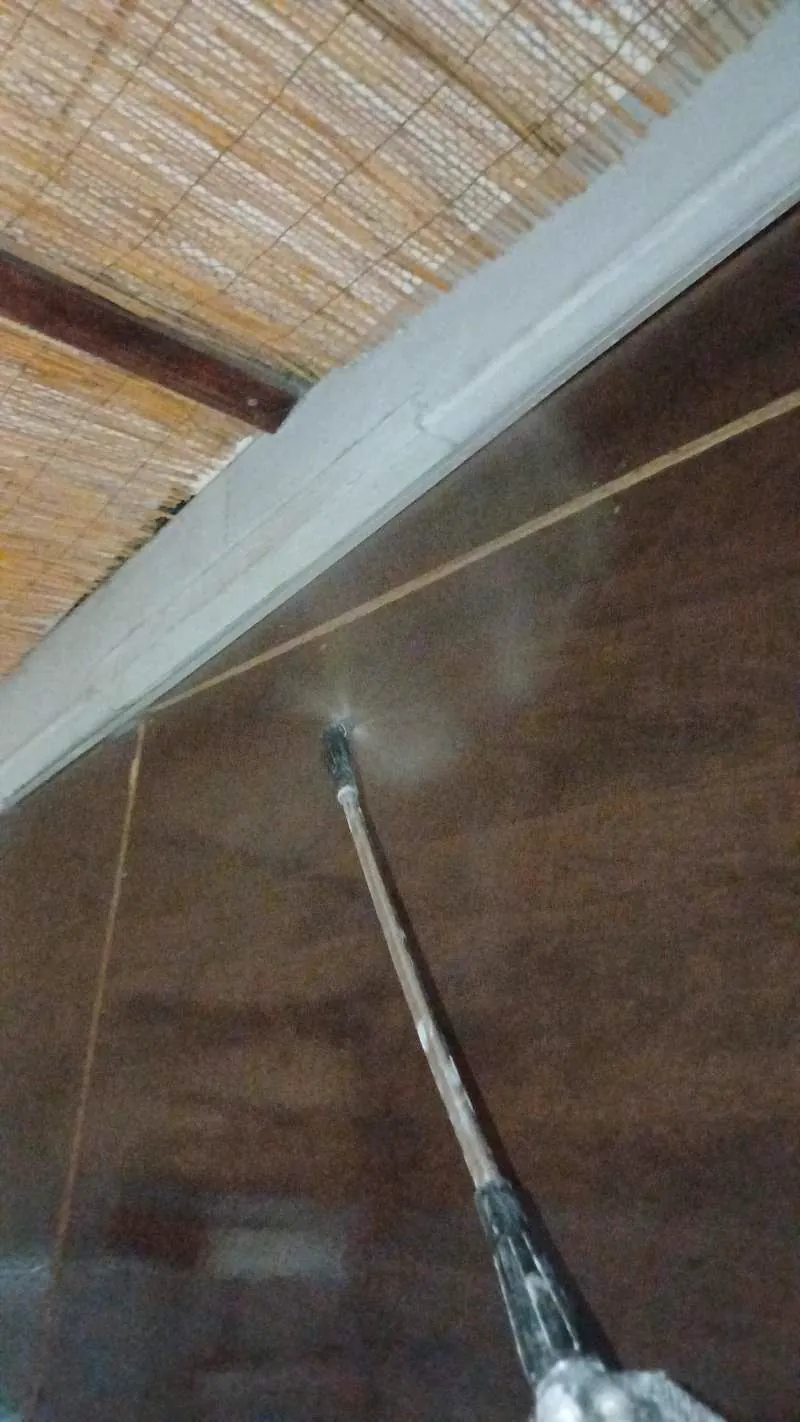
Spiders are where the food is. A house with lots of spiders is a house with lots of insects. That's why professional control works on both: a residual where spiders settle (meters, perimeter, ceiling, storage rooms, under garden furniture) and reducing the insects that attract them. Details on the spider control page.
On your side: remove webs and egg sacs with a broom every week, no cardboard boxes or undisturbed clothes in storage, shake out shoes, yellow outdoor lighting (it attracts fewer insects) and close gaps. The guide on how to seal your home explains where they get in.
What it costs
Spider treatment is part of the common household pest service: up to 100 m² ₡39,900, up to 200 m² ₡49,900, over 200 m² ₡59,900, VAT included, with no travel charge in the Greater Metropolitan Area. You can go back in one hour later. If you have not fumigated in the last 6 months, it takes two applications and the second one is charged; the 30-day check only applies once the plan is complete. Send us a photo on WhatsApp and we'll tell you if it's one that matters.
Frequently asked questions
Are there black widows in Costa Rica?
Yes. In urban areas the most common is the brown widow, of the same genus, with an orange hourglass mark. It lives in meters, garden furniture, concrete blocks and storage rooms. Its bite needs medical attention, although it's rarely fatal.
How do I know if it's a recluse spider?
Uniform brown with no patterns, slow, with a violin-shaped mark on the top of its body and six eyes in three pairs. It lives in boxes and stored clothes. In Costa Rica it's uncommon, and most brown spiders people see are harmless.
Is the tarantula dangerous?
No. Its bite hurts like a wasp sting and passes. The hairs it flicks off when frightened cause itching. Take it out to the garden with a bucket and a piece of cardboard.
Should I kill the long-legged spiders in the corners?
There's no need. They're harmless and hunt other insects and spiders. If the mess bothers you, a broom once a week is enough.